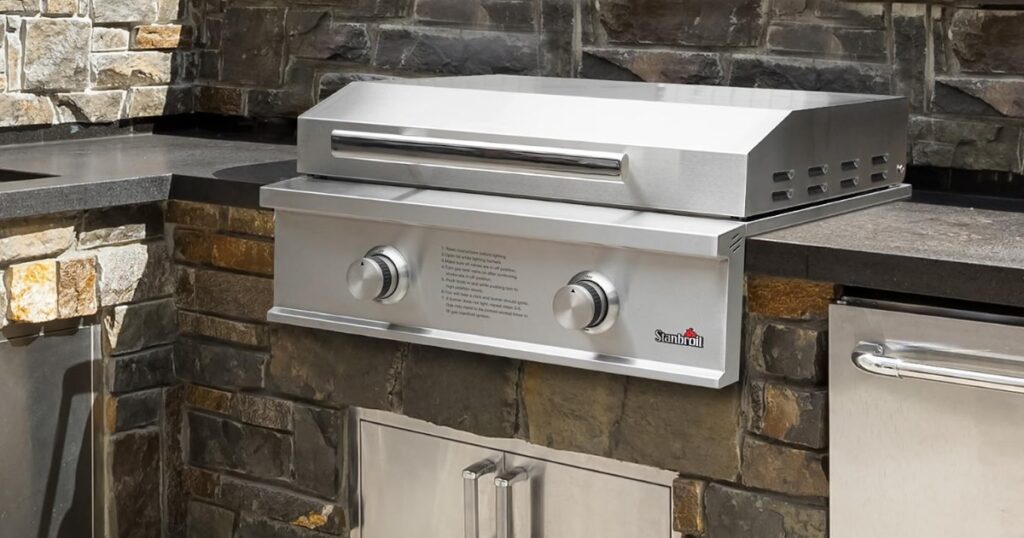

The short answer: 34,000 BTU across 412 square inches makes this one of the hotter 28-inch griddles per square inch you can buy, and the 304 stainless cooking surface is the part to think hardest about. It runs on natural gas, so the fuel never runs out mid-cook, and it drops into a cutout of 26 by 21.72 by 7.16 inches.
This Stanbroil 28-inch built-in natural gas griddle review is built from the Amazon listing for ASIN B0BQ71DSNL, Stanbroil’s own product page and standard outdoor-kitchen installation practice. We have not cooked on this griddle, so it carries no score. All figures are as published on 18 September 2026. See how we work.
Why you can trust us. Tools Soko earns a commission when you buy through links on this page. It never changes what we recommend, and it never changes the price you pay. As an Amazon Associate we earn from qualifying purchases.
Key figures
- Output: 34,000 BTU total, from two H-shaped steel tube burners rated 17,000 BTU each.
- Cooking surface: 25.2 in by 16.3 in, which Stanbroil states as 412 square inches. The multiplication gives 410.8, so the headline figure is rounded up.
- Heat density: 82.5 BTU per square inch, which is the number that matters more than the headline BTU.
- Cutout: 26 in long by 21.72 in wide by 7.16 in high.
- Fuel: natural gas only. Propane is a separate model, not a setting.
- Cooking surface material: 304 stainless steel.
- Gas use at full output: roughly 34 cubic feet of natural gas an hour, or 0.34 therms.
Stanbroil 28-inch built-in natural gas griddle specifications
| Brand / model | Stanbroil 28-inch built-in griddle |
| Amazon ASIN | B0BQ71DSNL (natural gas) |
| Fuel | Natural gas |
| Burners | 2 H-shaped steel tube burners, independently controlled |
| Output | 17,000 BTU per burner, 34,000 BTU total |
| Cooking area | 25.2 in × 16.3 in, stated as 412 sq in |
| Heat density | 82.5 BTU per sq in (Tools Soko arithmetic) |
| Cutout required | 26 in L × 21.72 in W × 7.16 in H |
| Cooking surface | 304 stainless steel |
| Lid | Hinged, included |
| Grease management | Removable drip tray |
| Propane version | Separate model, ASIN B0BQ716GZ9 |
| Insulated jacket | Sold separately, or as a bundle under ASIN B0HC1VL2RJ |
| Plate thickness, weight, warranty, certification | Not published |
What 34,000 BTU over 412 square inches actually means
BTU on its own tells you nothing. A big griddle with a big number can be cooler per square inch than a small griddle with a modest one, and heat per square inch is what decides whether the plate recovers when cold food lands on it.
Divide 34,000 BTU by 412 square inches and you get 82.5 BTU per square inch. Put that next to the 28-inch griddle most people compare against:
| Griddle | Output | Cooking area | BTU per sq in |
|---|---|---|---|
| Stanbroil 28-inch built-in | 34,000 BTU | 412 sq in | 82.5 |
| Blackstone 28-inch, two burner | 24,000 to 34,000 BTU depending on model | 517 to 524 sq in | 45.8 to 65.8 |
So the trade is plain. The Stanbroil gives up about 100 square inches of cooking space and puts more heat under what is left. For smash burgers, searing steak or anything that needs the plate to come straight back after a cold load, dense heat wins. For cooking breakfast for eight at once, area wins.
One caution on that arithmetic. Recovery also depends on how thick the plate is, because a thick plate stores heat and a thin one does not. Stanbroil does not publish a plate thickness, so the BTU density is the best available proxy rather than the whole story.
The 304 stainless surface is the real decision
Most flat tops people have cooked on, Blackstone included, use rolled carbon steel. This one uses 304 stainless, and the two materials behave differently in ways that show up on your first cook.
Carbon steel takes seasoning. Oil polymerises onto the surface, builds a dark patina over weeks, and turns into a release layer. It also rusts if you leave it wet, which is why carbon steel griddles live under covers and get oiled after every cook.
Stainless resists that process. It is chosen because it does not react, which is exactly why seasoning never bonds to it the way it does to carbon steel. Expect to cook with more fat, to preheat properly before food touches the plate, and to accept that eggs and fish are harder work than they are on a seasoned carbon top. In exchange you get a surface that does not rust when the cover leaks, does not need oiling after every cook, and can be scrubbed hard.
For a built-in that lives outdoors in one place for years, that trade is defensible. A carbon steel plate in a rainy climate is a maintenance job; stainless is not. Just buy it knowing which surface you are getting, because the reviews that call flat tops non-stick are almost always describing seasoned carbon steel.
One detail the listing leaves open: it says the griddle is made of 304 stainless, without separating the cooking plate from the body. Ask the seller to confirm the cooking plate itself is 304 before you buy on that basis.
Four numbers to check before anyone cuts the island
A built-in is a building job, not an unboxing. These are the four things that go wrong.
1. The cutout is 26 by 21.72 by 7.16 inches
Not 28 inches. The 28 in the name is the overall width including the flange that sits on the counter, and the hole underneath it is smaller. Cut to the published cutout, confirm it against the unit in front of you before the saw comes out, and remember the 7.16 inch depth still needs room below for the gas connection.
2. A combustible island needs an insulated jacket
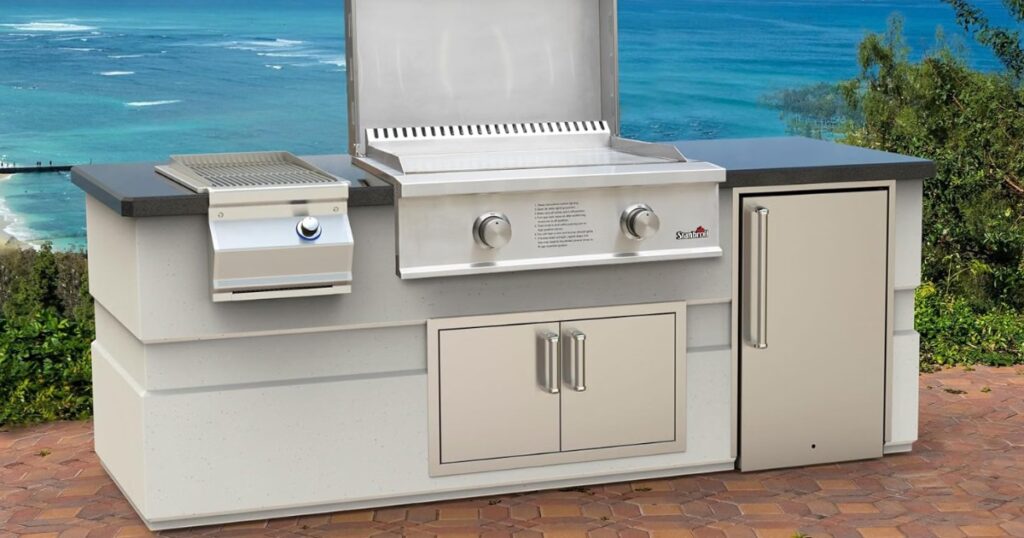
If the island is framed in wood, composite or anything else that burns, a stainless insulated jacket goes between the appliance and the frame. It is standard practice for built-in gas appliances and it is what stops heat soaking into the structure. Stanbroil sells the griddle and jacket as a bundle, which is the cheapest way to get both. Masonry islands are a different case, but check the clearances either way.
3. The gas line is sized for everything on it, not for this griddle
34,000 BTU is a modest load on its own. The question your gas fitter asks is the total connected load: this griddle plus the grill, the side burner and anything else on the same run, plus the length of pipe from the meter. Natural gas appliances typically expect around 7 inches of water column at the inlet, and a line that is long or undersized will not hold that when everything is lit. Stanbroil does not publish the inlet size or the required pressure, so have the installer confirm both from the manual that ships with the unit.
4. The island needs ventilation
An enclosed island with a gas appliance in it needs vents so that any leaked gas cannot collect, and so the cavity does not bake. Vent placement depends on the fuel, because propane is heavier than air and natural gas is lighter. Since this is the natural gas model, high venting matters most, and a gas fitter should sign the whole installation off against your local code.
Natural gas or propane: buy the model, not the conversion kit
This is the natural gas unit, ASIN B0BQ71DSNL. Stanbroil sells the same griddle as a propane model under ASIN B0BQ716GZ9, and it also offers a conversion kit which, in its own words, includes nozzles only.
Read that line carefully. Propane is delivered at a much higher pressure than natural gas and carries more than twice the energy per cubic foot, so a proper conversion is a matter of orifices and the pressure regulation ahead of them. Swapping nozzles alone, on an appliance whose regulator arrangement is not published, is not a job to improvise. If your home runs on propane, buy the propane model.
The upside of the natural gas version is the one that made you search for it. It never runs out. For contrast, 34,000 BTU an hour on propane burns roughly 1.6 pounds an hour, so a 20 pound tank gives about twelve hours of full-output cooking before someone has to drive to the exchange cage.
What Stanbroil does not publish
- Plate thickness. The single most useful number for a griddle, and it is absent. Thickness decides heat retention and how flat the plate stays over years of thermal cycling.
- Certification. We could not find a CSA or ETL listing stated for this griddle. For a permanently connected gas appliance, that is the first question to ask, because inspectors and insurers care about it.
- Warranty term. Not published on Stanbroil’s product page. Ask before you pay, in writing.
- Gas inlet size, required supply pressure and whether a regulator is included. All three decide what your installer needs to bring.
- Ignition type. The listing does not say whether it lights by push-button piezo, battery electronic ignition or a match.
- Weight and preheat time. Useful for handling and for planning a cook, and neither is stated.
None of these gaps is unusual at this end of the market. All of them are answerable by the seller before you commit, and a seller who cannot answer the certification question is telling you something.
Who it suits
Anyone building or filling an outdoor island who already has natural gas at the house. This is the whole point of the model. A fixed gas supply turns the griddle into an appliance rather than a thing you check the tank on before every cook.
Smash burger and steak cooks. 82.5 BTU per square inch is a lot of heat for the area, and independently controlled burners give you a hot zone and a holding zone across a surface this size.
People in wet or coastal climates. A stainless plate in an island that sits outside all year is a far smaller maintenance commitment than carbon steel.
Who should buy something else
Anyone without an island. Stanbroil sells the same size griddle as a freestanding cart, natural gas under ASIN B0FZSKYZ9R and propane under B0FZSP5QR1. Building an island to house a drop-in griddle is the expensive way round.
Cooks feeding a crowd at once. 412 square inches is roughly one full breakfast for four, not eight. If cooking volume is the goal, buy area.
Anyone who wants a seasoned, slick black top. That is carbon steel, and this is not that.
Propane households. Buy the propane model rather than converting this one.
Anyone who needs a documented certification before an inspection. Get that answer in writing first, whatever the griddle.
Tools Soko verdict
No score, because we have not cooked on it. What the published figures support is a clear picture: this is a hot, compact drop-in griddle that trades cooking area for heat density, and trades the release of a seasoned carbon top for the weather resistance of stainless.
Those are both reasonable trades for a built-in that will sit outdoors in one place for a decade. The gaps in the specification are the reason to ask questions before buying rather than after: no plate thickness, no stated certification, no published warranty, and no inlet or pressure figures for the person doing the plumbing.
Buy it for an island with natural gas already at the house, and budget for the insulated jacket and a gas fitter in the same breath as the griddle.
What you will need alongside it
- An insulated jacket, if the island is framed in anything combustible.
- A licensed gas fitter, and a permit if your area requires one for a fixed gas connection.
- A griddle scraper and a squeegee, because a stainless top is cleaned while it is hot.
- High smoke point oil, and more of it than a carbon steel top needs.
- A cover for the lid and surround, even though stainless will not rust the way carbon steel does.
Frequently asked questions
What size cutout does the Stanbroil 28-inch built-in griddle need?
26 inches long by 21.72 inches wide by 7.16 inches high. The 28 inches in the product name is the overall width including the flange that rests on the counter, so never cut the island to 28 inches.
How many BTUs does it produce, and is that enough?
34,000 BTU in total, from two burners of 17,000 BTU each. Spread across 412 square inches that is 82.5 BTU per square inch, which is higher than a typical 28-inch Blackstone at 46 to 66. It is plenty of heat for searing and smash burgers on a surface this size.
Can this griddle run on propane?
Not as supplied. It is built for natural gas. Stanbroil sells a propane version of the same griddle under ASIN B0BQ716GZ9, and a conversion kit that contains nozzles only. Because propane runs at a much higher pressure than natural gas, buying the propane model is the safer route.
How big is the cooking surface really?
25.2 inches by 16.3 inches, which multiplies out to 410.8 square inches. Stanbroil rounds this to 412 square inches. Think one comfortable breakfast for four rather than for eight.
Does food stick to a 304 stainless griddle?
More than it does on seasoned carbon steel. Stainless is chosen because it does not react, which is the same property that stops seasoning bonding to it. Preheat properly, use more oil, and expect eggs and fish to need care. The payoff is a surface that does not rust outdoors.
Do I need an insulated jacket?
Yes, if the island is framed in wood, composite or any other combustible material. The jacket is a stainless liner that keeps appliance heat out of the structure. Stanbroil sells a griddle and jacket bundle under ASIN B0HC1VL2RJ.
How much gas does it use per hour?
At full output, about 34 cubic feet of natural gas an hour, which is 0.34 therms. Natural gas carries roughly 1,000 BTU per cubic foot, so the arithmetic is simply the BTU rating divided by 1,000.
Is it certified for a permanent gas connection?
Stanbroil does not publish a CSA or ETL listing for this griddle that we could find. Ask the seller for the certification in writing before installation, because inspectors and home insurers generally expect a listed appliance on a fixed gas line.
How thick is the griddle plate?
Stanbroil does not publish a plate thickness, which is the most useful missing figure. Thickness governs how well the plate holds heat when cold food lands on it and how flat it stays after years of heating and cooling.
Is there a freestanding version?
Yes. Stanbroil sells a 28-inch freestanding griddle with folding side shelves in natural gas (ASIN B0FZSKYZ9R) and propane (B0FZSP5QR1). If you do not already have an island, that is the cheaper path to the same cooking surface.
More outdoor cooking and yard equipment is in Garden & Outdoor, and built-in kit for the house is in Home & Fixtures. For how we build a review without a bench test, see how we work.