
What this comparison is based on. Manufacturer specifications, plus findings reported in published head-to-head reviews by outlets that have run these saws side by side. Tools Soko has not tested them, so nothing here is scored and no comparative claim is ours. Where a ranking comes from someone else’s bench, this page says so. How we work sets out the line.
I am a DeWalt man. Most of what is in my case is yellow, the batteries all fit each other, and I have no interest in starting again on another platform.
But the DCS334 is not a cheap jigsaw, and a wallet is a wallet. So this is an honest look at what else does the same job, including two saws that cost a fraction of it, and one difference between them that nobody mentions until you have already paid.
Why you can trust us. Tools Soko earns a commission when you buy through links on this page. It never changes what we recommend, and it never changes the price you pay.
What the DeWalt DCS334 actually gives you
Worth being clear about the thing you are replacing before shopping for a substitute. The DCS334 is an 18V XR jigsaw with a brushless motor, and DeWalt lists the following:
- A tool-free blade change that holds the blade more securely and keeps it squarer through the cut
- Two LEDs and a built-in dust blower to keep the cut line visible
- A dual-sided AirLock-compatible extraction kit in the box
- Compatibility with over 100 tools on the same 18V XR battery
That last point is the one people underrate, and it is the reason switching is rarely as cheap as the sticker suggests. More on that further down.
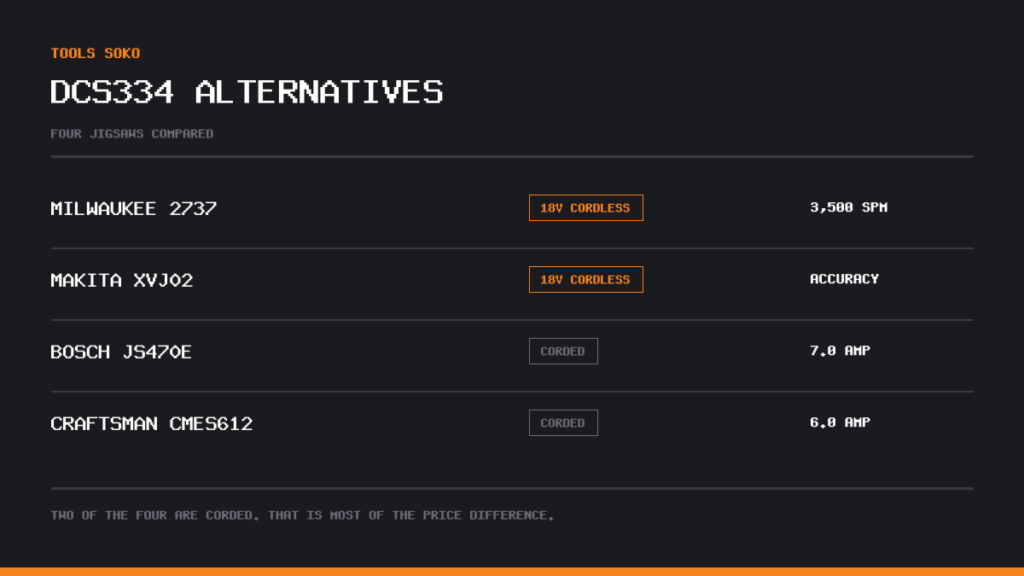
The four alternatives at a glance
| Saw | Power | Motor | Known for |
|---|---|---|---|
| Milwaukee 2737 | 18V cordless | Brushless | Blade speed, 3,500 SPM |
| Makita XVJ02 | 18V cordless | Brushless | Accuracy and vibration control |
| Bosch JS470E | Corded, 7.0 A | Brushed | Footplate rigidity, speed control |
| Craftsman CMES612 | Corded, 6.0 A | Brushed | Lowest cost of entry |
Read that power column twice. Two of these four are corded tools. They are not like-for-like alternatives to a cordless jigsaw, and the price gap is largely explained by the fact that you are not buying a battery. Whether that is a bargain or a downgrade depends entirely on where you work, which the next section deals with properly.
The corded question, before anything else
A jigsaw is a burst tool. You cut a curve, stop, reposition, cut again. That pattern is exactly where cordless earns its money, because setup time dominates and a trailing lead is a genuine nuisance on a bench covered in offcuts.
Corded still wins on two counts. It never runs flat, and it costs far less for the same output because there is no cell chemistry in the price. For a jigsaw that lives on a bench with a socket behind it, that is a real argument rather than a consolation.
| If you are | Look at |
|---|---|
| Already on 18V and moving around a site | Milwaukee or Makita |
| Cutting at a fixed bench with power to hand | Bosch or Craftsman |
| Buying a first jigsaw on a tight budget | Craftsman |
| Doing fine, visible joinery | Makita or Bosch |
| Already invested in DeWalt 18V XR | Probably the DCS334, for reasons set out below |
The fuller treatment of this trade-off is in our power tool buying guide.
Milwaukee M18 FUEL 2737
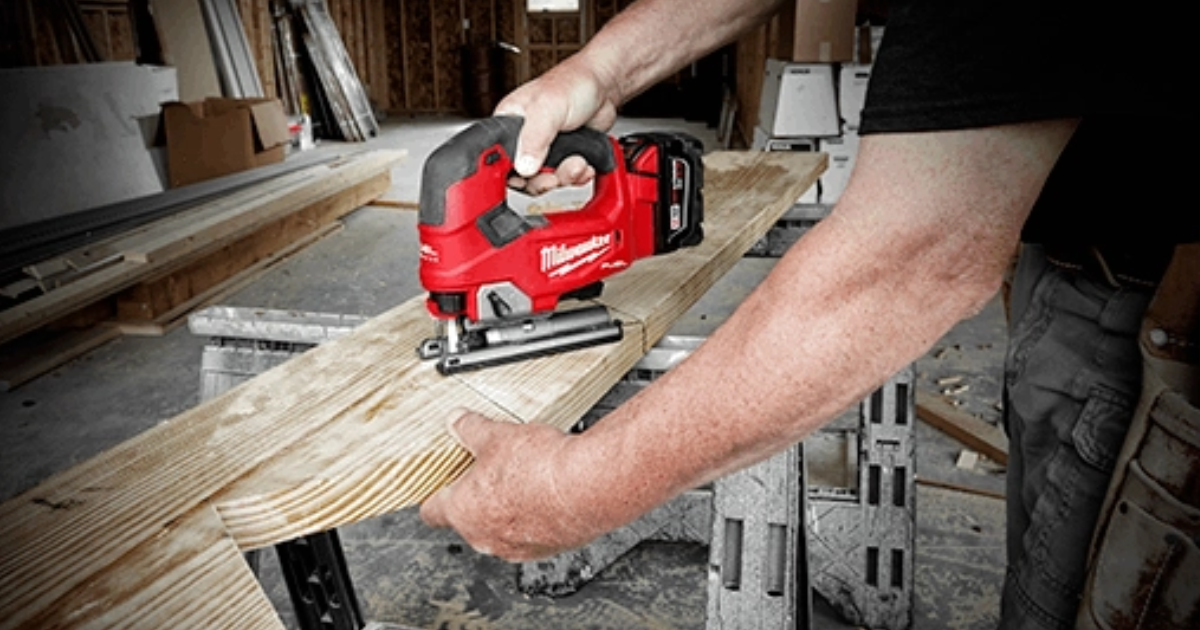
The speed option. Milwaukee publishes 3,500 SPM from its POWERSTATE brushless motor, and claims a higher blade speed than corded jigsaws. Also listed: four-position orbital cutting, tool-free bevel adjust with detents at 0, 15, 30 and 45 degrees, an LED with a switchable blower, and up to 105 linear feet of 19 mm laminated particle board on a 5.0Ah pack.
Published head-to-head reviews put it at the front for outright cutting speed. One caveat comes with that, and it is worth understanding rather than skipping: the fastest cuts need orbital action engaged, and orbital action leaves a rougher edge. Speed and finish pull against each other on every jigsaw. If your cuts get sanded, filled or hidden, take the speed. If the cut line is the finished edge, switch orbital off and the advantage narrows.
Not everyone is cutting 50 mm stock either. If most of your work is sheet goods, raw blade speed is not the specification that will change your day. See also our Milwaukee brand profile.
Makita 18V LXT XVJ02
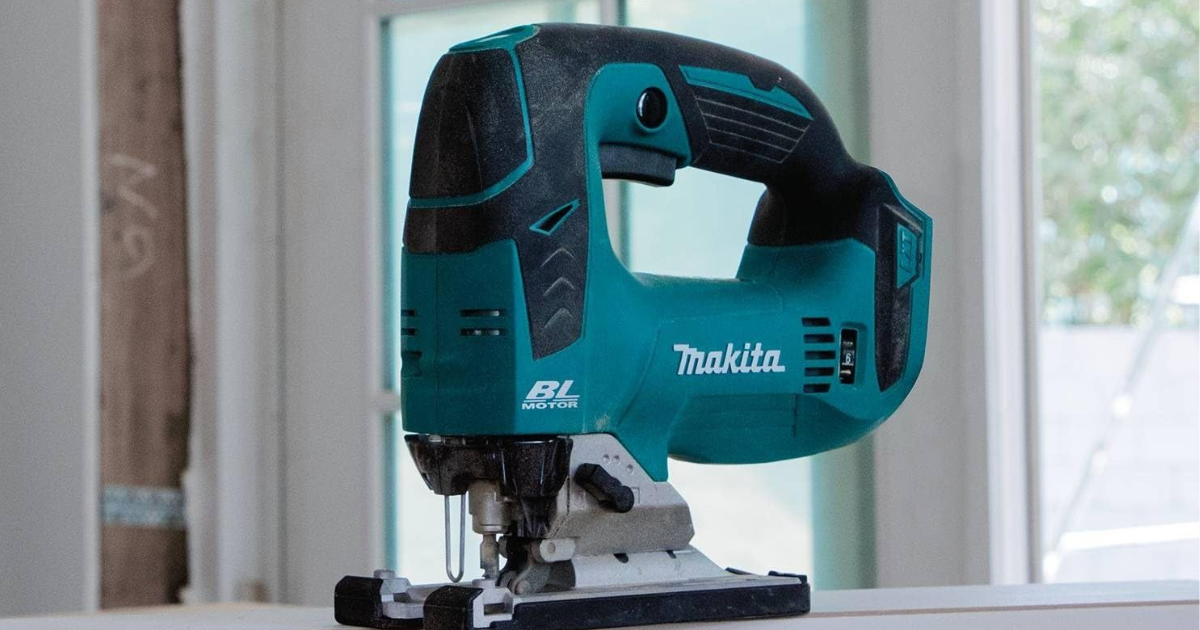
The accuracy option. Getting a jigsaw to follow a line is a combination of four things: seeing the line, tracking, resisting blade deflection, and keeping vibration low enough that your hand is still steady after twenty minutes.
Reviewers who have run these saws side by side report Makita as the strongest of this group on exactly that combination, in both the top-handle XVJ02 and the barrel-grip XVJ01. We have not verified it ourselves, and it is a comparative judgement rather than a published number, so treat it as informed third-party opinion rather than fact.
The barrel grip deserves a thought if you cut a lot of curves. Your hand sits lower and closer to the shoe, which most people find easier to steer and harder to use one-handed. Neither layout is better; they suit different work. See also our Makita brand profile.
Bosch JS470E
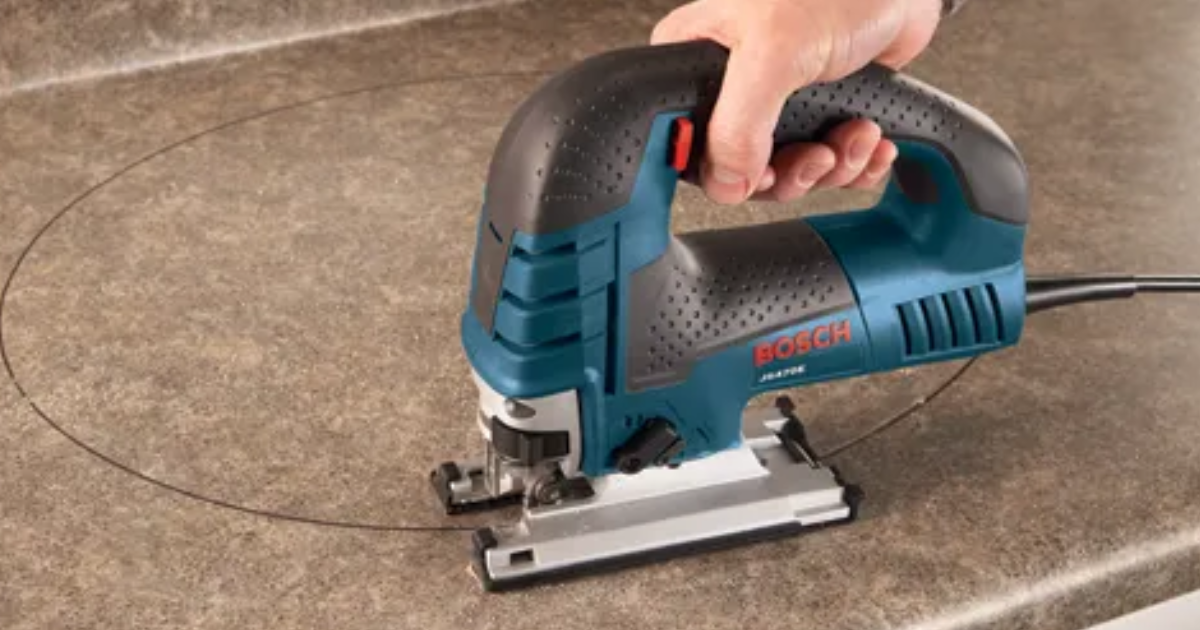
The corded one that is not a compromise. Bosch lists a 7.0 amp motor, the stronger of the two mains saws here, and the specification reads like a tool designed by people who use one:
- Large die-cast aluminium footplate with a steel insert. Footplate rigidity is most of what keeps a jigsaw cutting square, and cast aluminium beats pressed steel for it.
- Constant Response circuitry, which Bosch says holds speed under load. That matters when the blade bites into something dense mid-cut.
- Variable speed two ways: a dial that caps maximum speed, and a trigger to modulate beneath it. Set the ceiling for the material, then feather the trigger.
- Four orbital settings, from smooth to aggressive.
- Toolless blade change with an ejection lever, so you are not pulling a hot blade out by hand.
- Bevel hex key stored on board, which sounds trivial until it is the key you have lost.
One limitation to check before you buy
The JS470E takes T-shank blades only. It does not accept U-shank.
T-shank is the modern standard and what most merchants stock, so for most buyers this is a non-issue. But if you have inherited a box of U-shank blades, or you buy where U-shank is what sits on the shelf, that box will not fit this saw. Check what your usual supplier actually carries before ordering. See also our Bosch brand profile.
Craftsman CMES612
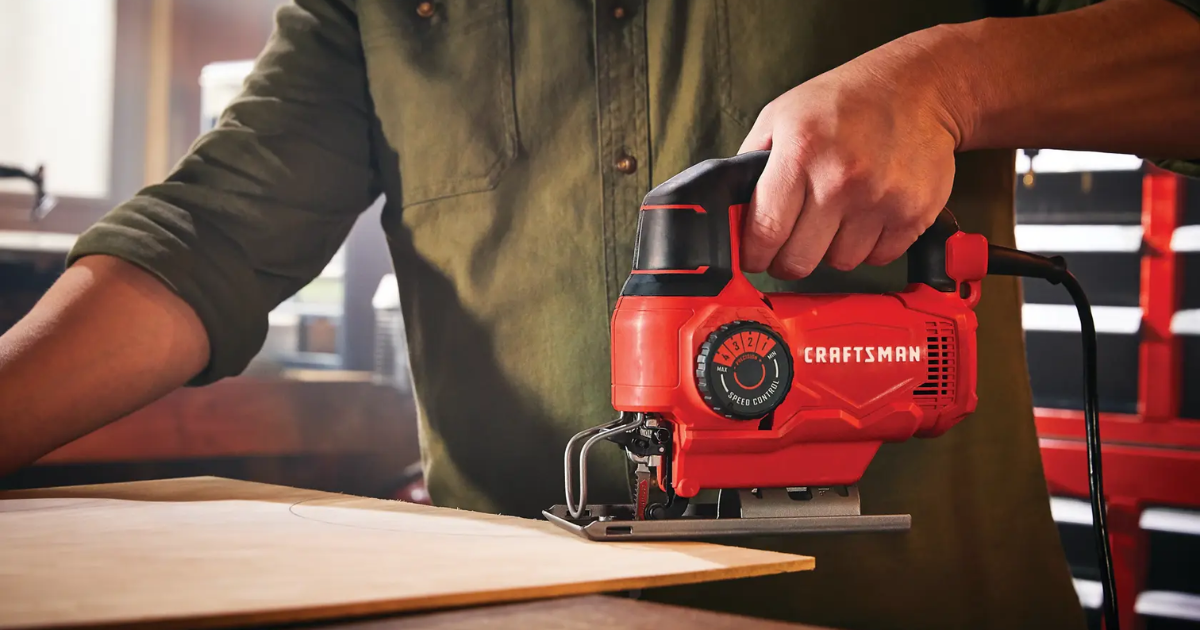
The cheapest way to own a working jigsaw. A 6 amp corded saw with variable speed, orbital settings, and a bevelling shoe that pivots to 45 degrees for angled cuts.
That is a genuinely complete feature list for occasional work. Variable speed, orbital action and a bevel cover most of what a jigsaw gets asked to do around a house. What you give up against the Bosch is a lower amperage motor and, on the evidence available, a less substantial footplate, which matters more the more the cut has to be square.
If the saw comes out a few times a year, this is the honest answer and the rest of this page is you overthinking it.
Who should just buy the DeWalt
This is the part a page titled “alternatives” usually skips.
If you already own DeWalt 18V XR batteries, the DCS334 is a bare-tool purchase. Every cordless alternative here is a bare tool plus a battery plus a charger, unless you intend to run that second platform properly. Once a pack and a charger go in the basket, the saving you were chasing often disappears, and you are left maintaining two chargers and two sets of packs to own one saw.
Switch platforms when you are switching platforms, not to save money on a single tool. A corded saw sidesteps the whole question, which is why the Bosch and the Craftsman are the two genuinely cheaper answers on this page rather than the two cordless ones.
Our combo kit guide covers the platform maths in more detail, and the DeWalt brand profile covers where that range is strong.
What we cannot tell you
No prices. Jigsaw pricing moves constantly, varies by market, and varies again depending on whether a tool is sold bare or as a kit. Any figure printed here would be wrong within a month.
The available information also does not give us stroke length, maximum cutting depth in timber or steel, weight, or noise and vibration figures for any of these saws, nor a published SPM for the Makita, the Bosch or the Craftsman. Those are worth asking for, because stroke length and cut capacity decide whether a saw suits your material at all.
Tools Soko verdict
The honest shape of this comparison. Two of these four are cordless saws on rival platforms, and for anyone already holding DeWalt batteries they are not cheaper in any way that survives contact with a checkout. The two corded saws are genuinely cheaper, and what they give up is mobility rather than capability.
Choosing on merit rather than price. Milwaukee for blade speed, on a published 3,500 SPM, accepting that the fastest cuts come with a rougher edge. Makita if the cut line is the finished edge, on the strength of third-party accuracy findings we have not verified. Bosch if a lead is acceptable and you want a rigid footplate and real speed control for less money. Craftsman if the saw is an occasional tool and the budget is the specification.
What to check first. Blade shank compatibility against whatever your supplier stocks, then stroke length and cut capacity against your usual material. Neither appears in the marketing copy for most of these saws, and both decide more than the headline motor figure does.
Worth investigating further? Yes on the Bosch, which looks like the most tool for the least money provided you can live with the cord. And note the framing that produced this page: it started as a search for something cheaper than a DCS334, and the most useful finding is that on a platform you already own, cheaper mostly is not.
Where to buy
All five saws are widely sold online and through tool merchants. Two things worth doing before ordering: confirm whether the listing is a bare tool or a kit, because that single detail explains most confusing price gaps on cordless saws, and confirm which blade shank the saw accepts.
If you are buying in Kenya, our guide to buying power tools in Nairobi covers counterfeits, grey imports and which warranties are honoured locally.
Frequently asked questions
Is a cordless jigsaw worth it over corded?
For a jigsaw specifically, yes more often than for most tools, because it is used in short bursts where a trailing lead is the main irritation. The exception is a saw that lives on a bench next to a socket, where corded costs less for the same output and never runs flat.
What is orbital action, and should I use it?
Orbital action swings the blade forward into the cut as it rises, rather than moving it straight up and down. It cuts noticeably faster and leaves a rougher edge. Use it for rough work and switch it off when the cut line is the finished edge.
T-shank or U-shank blades?
T-shank is the current standard and fits the widest range of saws, including all the cordless ones here. The Bosch JS470E accepts T-shank only. If you already hold U-shank blades, check compatibility before buying any modern jigsaw.
Top handle or barrel grip?
Top handle is easier one-handed and more familiar to most people. Barrel grip puts your hand lower and closer to the shoe, which most find easier to steer through curves. Makita offers both, as the XVJ02 and the XVJ01 respectively.
Does brushless matter on a jigsaw?
It buys runtime, cooler running and longer motor life, which pay back under sustained load. A jigsaw runs in bursts, so the return is smaller than on a grinder or a circular saw. It is a reason to prefer brushless, not a reason to reject a good brushed saw.
Where to go next
For another saw assessed from its published specifications, see our DeWalt DWE575 review and the angle grinder guide. The platform question behind this whole page is covered in the power tool buying guide, and how we work explains why this comparison carries no score.
DeWalt’s five new carpentry tools for 2026 covers what is arriving next on the same 20V platform.