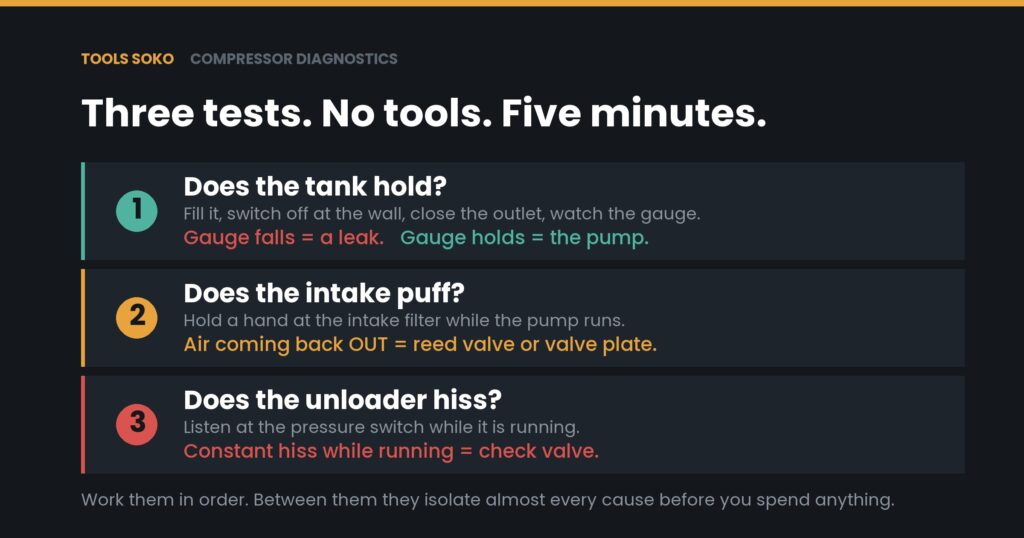

Three tests, no tools, about five minutes. Between them they isolate almost every cause of a compressor that runs and achieves nothing, and you can do all three before spending anything.
What this is based on. What this guide is based on. Manufacturer service documentation and widely reported owner experience. We have not reproduced each fault on a bench. See how we work.
This guide is built from how piston compressors work and from the failure modes common to them. It is not a bench test. See how we work.
Why you can trust us. Tools Soko earns a commission when you buy through links on this page. It never changes what we recommend, and it never changes the price you pay. As an Amazon Associate we earn from qualifying purchases.
A compressor that will not build pressure is failing in one of two places. Either it is making air and losing it, or it is not making air at all. Almost every troubleshooting list mixes those together into ten undifferentiated causes. Separating them first is what turns this into a short job.
Test one: does the tank hold?
Run the compressor up to whatever pressure it manages, switch it off at the wall, close the outlet valve and leave it. Watch the tank gauge for a few minutes.
- The needle falls. You are making air and losing it. The fault is a leak, and the next section is where to find it.
- The needle holds. The tank and its fittings are sound, so the pump is not producing. Skip to the pump section.
That one observation halves the problem, and it is the step people skip on their way to buying parts they did not need.
Test two: does the intake puff?
With the pump running, hold a hand near the intake filter. You should feel air being drawn in.
If you can feel air puffing back out, the diagnosis is effectively made: the reed valves in the pump head are not sealing. Instead of being pushed forward into the tank, air is being pushed back out through the intake. This is the most common repairable pump fault there is.
A related tell: a machine that climbs willingly to somewhere around 40 to 80 PSI and then stalls, running on and on without reaching cut-out, is behaving exactly as a compressor with a failing reed valve behaves.
Test three: does the unloader hiss while it runs?
A short hiss a second or two after the motor stops is correct. That is the unloader venting the line so the motor can restart against nothing, and its absence points at a different fault entirely, covered in why an air compressor trips the breaker.
A continuous hiss while the motor is still running is a different matter. That is compressed air escaping back out of the system as fast as the pump makes it, and the usual culprit is the check valve, which should be holding tank pressure back and is not.
Symptom to cause
| What you see | Likely cause | Cost to fix |
|---|---|---|
| Gauge falls with the machine off | Leak: drain valve, fitting, hose, coupler | Usually nothing |
| Air puffs back out of the intake | Reed valves or valve plate | Valve plate kit, if one exists |
| Constant hiss while running | Check valve | Inexpensive part |
| Stalls around 40–80 PSI | Reed valves | Valve plate kit |
| Builds, but slowly and to less than it used to | Clogged intake filter, then wear | Filter is pennies |
| Runs hot, uses oil, output falling | Worn rings or bore | Often terminal |
| Cuts out early at the wrong pressure | Pressure switch | Inexpensive part |
If it is losing air
Start with the drain valve
The tank drain sits underneath, it is opened routinely to release condensate, and it is left open or half closed more often than anyone admits. It is the first thing to check and the least expensive lesson in the category.
Then soapy water, everywhere
Washing-up liquid in water, brushed onto every joint with the tank pressurised. Leaks blow bubbles. Work through the tank fittings, the pressure switch connections, the regulator, the outlet coupler, the hose and its ends.
Pay particular attention to quick-connect couplers, which are the most common leak point on any compressor and the easiest to dismiss because the hiss is quiet. A leak runs continuously, so on a small machine it can consume a meaningful share of total output and make the pump cycle when nothing is being used.
If it is not making air
The intake filter, first
A pump can only compress what it can breathe. A filter clogged with workshop dust starves the cylinder, and the symptom is a machine that builds slowly and tops out lower than it used to. It costs almost nothing and takes a minute, so eliminate it before opening anything.
Reed valves and the valve plate
This is the fault the intake test finds, and it is worth understanding because it explains the symptom exactly.
Between the cylinder and the head sits a valve plate carrying thin metal reeds. They flex open and shut hundreds of times a minute, letting air in on the down stroke and out to the tank on the up stroke. When a reed cracks, warps or carbons up, it stops sealing, and air that should be pushed forward is pushed backward instead. The pump works hard, gets hot, and delivers little.
The remedy is a valve plate or gasket kit. On oil-lubricated cast iron pumps these are ordinary stock items and the repair is genuinely worth doing.
The head gasket
A blown gasket between the cylinder head and the valve plate lets compressed air escape internally rather than reaching the tank. Symptoms overlap almost entirely with reed valve failure, which is convenient, because the two are usually replaced together as one kit.
The check valve
Sitting between pump and tank, its job is to let air in and refuse to let it back out. When it fails, tank pressure bleeds back through the pump and out of the unloader, which is the continuous hiss from test three. It is an inexpensive part and a straightforward replacement.
Worn rings, which is the end of the road
If everything else checks out and the machine is old, the piston rings or the bore have worn past the point of sealing. The giveaway is a cluster rather than a single symptom: falling output, a pump running hotter than it used to, and on an oil-lubricated machine, rising oil consumption as it gets past the rings.
On a cast iron pump this is a rebuild. On most others it is a new compressor.
Before you order a part, check one exists
This is where the economics bite, and it is the honest thing most repair guides leave out.
Oil-lubricated cast iron pumps are designed to be serviced. Valve plates, gaskets, rings and bearings are catalogued parts, and a rebuild on a good pump is worth doing more than once.
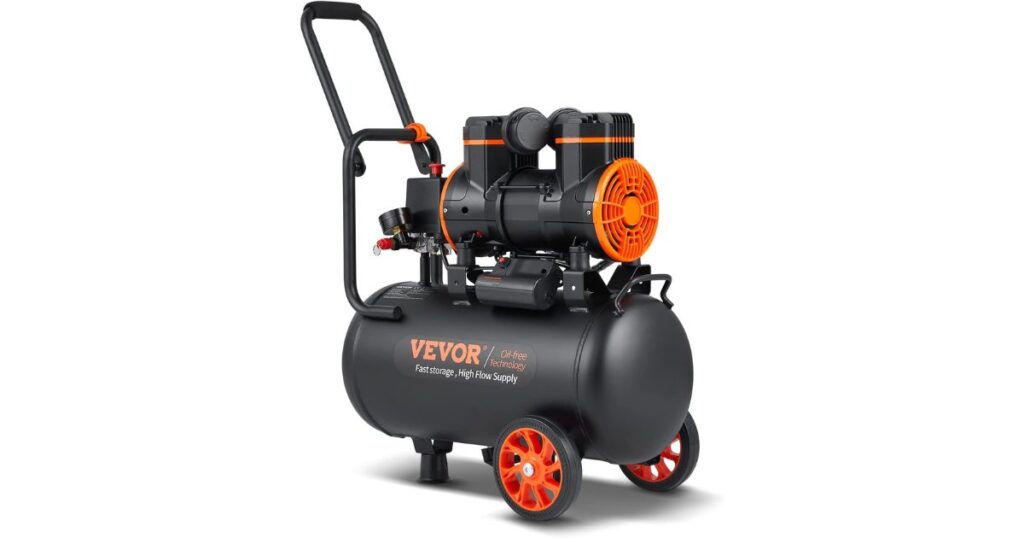
Small oil-free pumps frequently are not. They run hotter, wear faster and are often sold as a sealed assembly with no serviceable parts behind it. On a machine at that end of the market the diagnosis may be perfect and the repair still impossible, which is a point worth knowing before you take the head off. We covered where that line sits in our VEVOR 6.3 gallon review and in the buying guide.
So: run the three tests, name the fault, then search for the part number for your specific model. If nothing comes up, you have your answer and you have not lost an afternoon.
Keeping it from happening again
- Drain the tank after every session. Condensate collects, and a rusting tank is both a pressure problem and eventually a safety one.
- Clean or replace the intake filter on a schedule rather than when output falls off.
- Fix small leaks immediately. They never get better and they make the pump work when nobody is using it.
- Respect the duty cycle. Heat is what kills reeds and rings, and a machine asked to run beyond its rating gets hot by design rather than by fault.
Frequently asked questions
Why does my air compressor run but not build pressure?
It is either making air and losing it, or not making air at all. Fill the tank, switch off, close the outlet and watch the gauge. If the needle falls you have a leak, most often the drain valve or a quick-connect coupler. If it holds, the pump is at fault, and the usual cause is the reed valves in the pump head.
Why does my compressor stop at 40 or 60 PSI?
A machine that climbs to somewhere around 40 to 80 PSI and then runs on without reaching cut-out is the classic reed valve symptom. Confirm it by holding a hand at the intake filter while it runs: if you feel air puffing back out rather than being drawn in, the valves in the head are not sealing and the fix is a valve plate kit.
What is a reed valve and why does it fail?
Thin metal flaps on a plate between the cylinder and the head, opening and closing hundreds of times a minute to admit air and push it to the tank. They crack, warp or carbon up with heat and age. Once one stops sealing, air gets pushed backwards instead of forwards, so the pump works hard, runs hot and delivers very little.
What does a constant hiss while running mean?
Usually a failed check valve. That valve sits between pump and tank and should stop stored air escaping back through the pump and out of the unloader. A brief hiss a second or two after the motor stops is normal and correct; a continuous hiss while it is still running is not, and the part is inexpensive.
How do I find an air leak on a compressor?
Washing-up liquid in water, brushed onto every joint with the tank pressurised. Leaks blow bubbles. Check the drain valve first because it is left open more often than anything else, then the quick-connect couplers, which are the most common genuine leak point and the quietest.
Is it worth repairing an air compressor that will not build pressure?
It depends entirely on the pump. Oil-lubricated cast iron pumps are designed to be serviced and valve plates, gaskets and rings are catalogued parts, so a rebuild is usually worth it. Small oil-free pumps are often sealed assemblies with nothing sold behind them. Diagnose the fault, then check a part number exists for your model before taking anything apart.
Can a dirty air filter stop a compressor building pressure?
Yes, and it is the cheapest thing on the list to rule out. A pump can only compress the air it can draw in, so a filter clogged with workshop dust makes the machine build slowly and top out below its normal cut-out pressure. Clean or replace it before opening the pump.
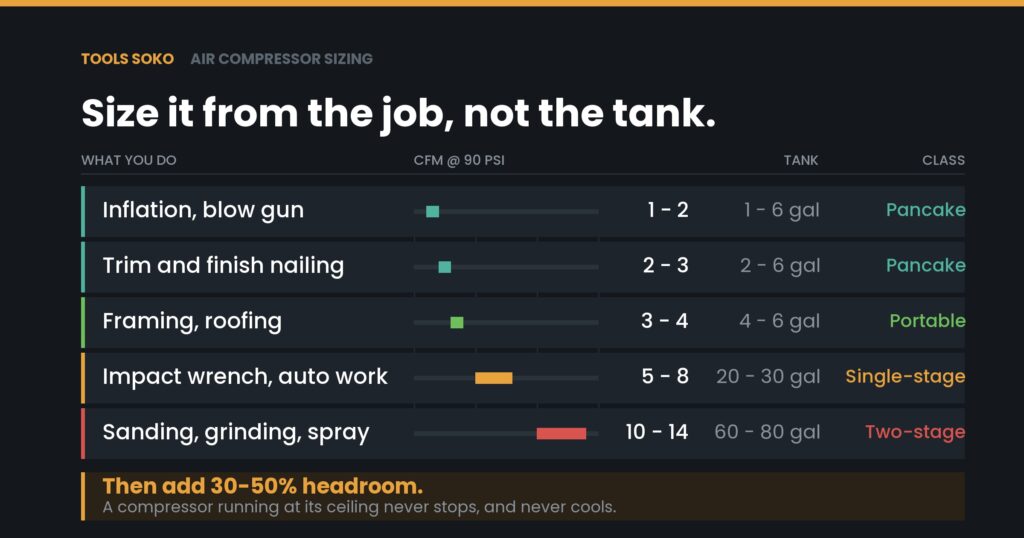
Part of our air and pneumatics series. If it cuts out rather than under-delivers, why an air compressor trips the breaker. If it keeps up with nothing you own, that is a sizing problem: what size air compressor do I need and CFM explained.