
A compressor advertised at “5.5 CFM” tells you nothing. Without a pressure attached, the figure is not a specification, and the pressure chosen is where most of the marketing happens.
What this is based on. What this explainer is based on. Published manufacturer specifications and industry standards for air tool consumption. No figure here is one we measured. See how we work.
This explainer is built from how compressors and air tools are rated, and from the demand figures manufacturers publish for common tools. It is not a bench test. See how we work.
Why you can trust us. Tools Soko earns a commission when you buy through links on this page. It never changes what we recommend, and it never changes the price you pay. As an Amazon Associate we earn from qualifying purchases.
CFM is cubic feet per minute: how much air a compressor delivers, or a tool consumes. It is the specification that decides what you can actually run, and horsepower and tank size are both distractions beside it.
The pressure is half the specification
Air is compressible, so the volume a pump can move depends entirely on how hard it is being asked to squeeze. The same machine that delivers 5.5 CFM at 40 PSI might deliver 3.9 at 90 PSI. Both numbers are true. Only one is useful.
90 PSI is the reference point, because that is roughly what most air tools are designed to run at. A rating quoted at 40 PSI is a bigger number describing a pressure at which almost nothing useful happens. When a listing leads with the 40 PSI figure, or gives no pressure at all, that is a choice rather than an oversight.
So the only comparison worth making between two compressors is CFM at 90 PSI, and if a seller will not give you that number, you have learned something.
Three kinds of CFM, and only one of them is honest
| Term | What it measures | Use it? |
|---|---|---|
| SCFM Standard CFM | Delivered flow corrected to defined standard conditions so two machines can be compared | Yes. This is the comparable figure |
| ACFM Actual CFM | Flow at your actual conditions of pressure, temperature and humidity | Useful in engineering, rare on consumer listings |
| Displacement CFM | The theoretical volume the pump sweeps, before losses | No. Always higher than what reaches your tool |
Displacement CFM is the one to watch. It is the pump’s theoretical sweep per revolution and it ignores heat, leakage past the rings and every other real-world loss. It is always a larger number than delivered air, and it is the figure a brand reaches for when the honest one is unimpressive.
This is the same manoeuvre as quoting peak horsepower from input watts, which we worked through in our VEVOR 6.3 gallon compressor review: a real measurement, of the wrong thing, wearing the name of the right one.
Intermittent or continuous: the distinction that decides everything
Before any table is useful, this has to be clear, because it explains why a small compressor runs a nailer all day and dies on a sander in a minute.
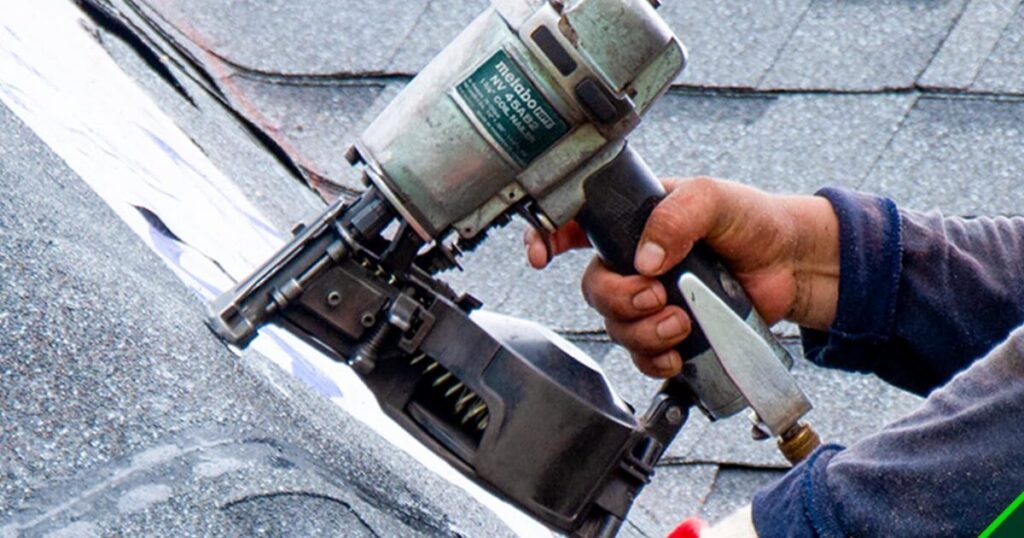
Intermittent tools take a gulp and stop. A nailer fires, and in the seconds before the next shot the pump refills the tank. Average demand over a working minute is far below the instantaneous figure, so a modest compressor keeps pace indefinitely.
Continuous tools draw the whole time the trigger is down. A sander or a die grinder consumes air without pause, so once demand passes delivery the tank drains, pressure falls, and the tool slows. No tank is large enough to fix that, it only changes how long the disappointment takes to arrive.
What each air tool actually needs
Typical demand at 90 PSI. Individual models vary, sometimes considerably, so check the figure for the tool in front of you before committing.
| Tool | Typical CFM at 90 PSI | Demand |
|---|---|---|
| 18ga brad nailer | 0.3 | Intermittent |
| Narrow crown stapler | 0.4 | Intermittent |
| 16ga finish nailer | 0.5 | Intermittent |
| Tyre inflation | 1–2 | Intermittent |
| Framing nailer | 2.2 | Intermittent |
| Coil roofing nailer | 2.5 | Intermittent |
| Blow gun | 2–4 | Bursts |
| Air hammer or chisel | 3–5 | Continuous |
| 3/8 in air ratchet | 3–4 | Continuous |
| 3/8 in air drill | 4 | Continuous |
| 1/2 in impact wrench | 4–5 | Continuous |
| Cut-off tool | 4–6 | Continuous |
| HVLP spray gun | 4–12 | Continuous |
| Die grinder | 5–8 | Continuous |
| Random orbit sander | 6–10 | Continuous |
| 3/4 in impact wrench | 7–10 | Continuous |
| 7 in grinder | 8–12 | Continuous |
| Sandblaster | 6–20 | Continuous |
Read the table by demand column rather than by number. A framing nailer at 2.2 CFM and an air ratchet at 3 CFM look adjacent, and they are not remotely the same ask.
How to size it
- Find the hungriest tool you will genuinely use. Not the one you might buy one day. The one that will be on the hose.
- Add 30 to 50 per cent. A compressor running at its rated ceiling never stops, which cooks it and wears it out. Headroom is the difference between a machine that cycles and one that runs continuously.
- If two people will work at once, add the two figures together before applying headroom. Air does not queue politely.
- Check the result against the pressure. Confirm the compressor’s number is quoted at 90 PSI, not 40.
Worked example. A 1/2 inch impact wrench at 5 CFM, plus 40 per cent headroom, needs about 7 CFM at 90 PSI. That is well beyond the small oil-free machines sold for nailing, and it is why people who buy a pancake compressor for tyre work end up buying a second compressor for the impact wrench.
What steals CFM after it leaves the tank
You can buy enough compressor and still starve the tool, because the delivery system has its own losses and almost nobody accounts for them.
- Hose diameter. The 1/4 inch hose that ships with most compressors is a real restriction above roughly 4 to 5 CFM. Moving to 3/8 inch internal diameter is the single cheapest upgrade for anyone running continuous tools, and it costs less than the tool you are starving.
- Hose length. Pressure drop accumulates along the run. Two 25-foot hoses coupled together are worse than one 50-foot hose, because every joint is a restriction.
- Quick-connect couplers. Standard industrial couplers choke flow more than most people expect. High-flow couplers exist precisely because of this, and on a die grinder the difference is noticeable.
- Leaks. A leak runs 24 hours a day. On a small compressor a slow hiss at a fitting is a meaningful share of total output, and it makes the pump cycle when nothing is being used.
- Regulator setting. If the tool needs 90 PSI at the inlet and you have set the regulator to 90 at the tank, the tool is not getting 90 once the hose has taken its share.
Tank size is not a substitute for CFM
A tank is a buffer, not a supply. It stores a fixed quantity of compressed air and lends it to you faster than the pump can make it, which is exactly what an intermittent tool needs.
For a continuous tool the tank only sets how long you get before reality arrives. Once it is drained, output is whatever the pump makes, and a six gallon tank and a twenty gallon tank behind the same pump deliver identical air to a running sander. The larger tank simply took longer to disappoint you.
Where tank size genuinely earns its keep is cycle frequency. A bigger tank means fewer starts per hour, and fewer starts means less inrush current and less wear — which matters if your machine is tripping a breaker on start-up.
Once you know what your tools demand, the next step is matching a machine to it. what size air compressor do I need turns these figures into a tank size, a compressor class and a supply requirement.
Frequently asked questions
How much CFM do I need for air tools?
Take the highest-demand tool you will actually run and add 30 to 50 per cent. Nailers need under 3 CFM at 90 PSI and suit small compressors. Impact wrenches, grinders, sanders and spray guns need 4 to 12 CFM continuously and need a substantially bigger machine. If two people will work at once, add their figures together before applying headroom.
What is the difference between CFM and SCFM?
SCFM is flow corrected to defined standard conditions so that two machines can be compared like for like. Plain CFM on a consumer listing may mean SCFM, actual flow, or pump displacement, and displacement is always the largest and least useful of the three. What matters more than the acronym is that both figures you are comparing are quoted at the same pressure, normally 90 PSI.
Why is CFM quoted at 40 PSI on some compressors?
Because it is a bigger number. Air is compressible, so a pump delivers more volume when it is squeezing less hard. Very few air tools run at 40 PSI, so the figure describes a condition you will not use. Compare at 90 PSI, and treat a listing that only offers the 40 PSI number as having told you something about itself.
Can I run an impact wrench on a small pancake compressor?
Briefly, then no. A 1/2 inch impact wrench wants 4 to 5 CFM continuously and a pancake compressor typically delivers 2 to 3.5. You will get a few seconds of stored air from the tank, then the pressure falls and the tool loses its punch. For occasional wheel nuts people manage by working in bursts; for anything sustained it is the wrong machine.
Does a bigger tank mean more CFM?
No. The tank stores air, the pump makes it. A bigger tank lends you more before it runs out, which helps intermittent tools and does nothing for continuous ones. Once the tank is drained you have whatever the pump delivers, regardless of how large the tank was. It does reduce how often the motor starts, which reduces wear.
Does hose size affect CFM at the tool?
Yes, and more than most people expect. The 1/4 inch hose supplied with most compressors restricts flow above roughly 4 to 5 CFM. Going to 3/8 inch internal diameter, keeping the run as short as practical, and fitting high-flow couplers can be the difference between a sander that works and one that does not, without touching the compressor.
How much CFM does a spray gun need?
Anywhere from 4 to 12 CFM continuously depending on the gun, and it is the most commonly underestimated figure in the category. Small detail and touch-up guns sit at the bottom of that range; a conventional HVLP gun spraying panels sits near the top. If the compressor is the obstacle, an airless sprayer removes the requirement entirely, as we covered in our airless sprayer review.
Part of our air and pneumatics series. For choosing a machine, see the air compressor buying guide. For a worked example of these figures on a real machine, the VEVOR 6.3 gallon review. And if yours keeps cutting out, why an air compressor trips the breaker.