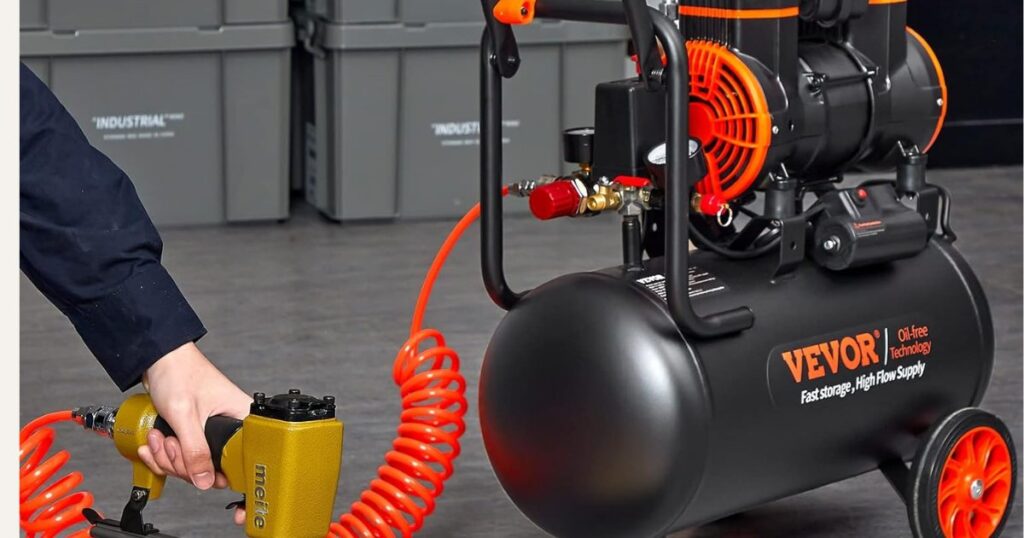

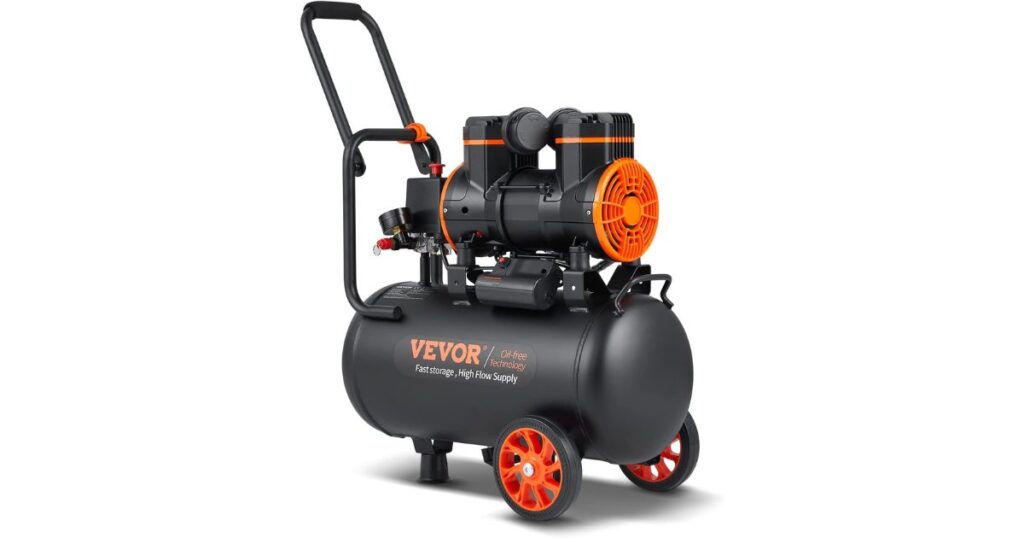
VEVOR sells this as a 2 HP compressor. The motor is 1450 watts. Both statements are on VEVOR’s own page, and the gap between them explains most of what this machine can and cannot do.
This review is built from VEVOR’s published specifications for SKU W24L1450W110VCQNYV1, the Amazon listing for ASIN B0BV644LGX, and 960 owner reviews on VEVOR’s own site. We have not run this compressor, so it carries no score. See how we work.
Why you can trust us. Tools Soko earns a commission when you buy through links on this page. It never changes what we recommend, and it never changes the price you pay. As an Amazon Associate we earn from qualifying purchases.
Air compressors are sold on two numbers that do not matter much and one that decides everything. Horsepower is marketing. Tank size is comfort. CFM at 90 PSI is the specification that tells you which tools will actually work, and this machine publishes 3.35 of it.
That figure is the whole review. Everything below is what it buys you and where it runs out.
Specifications
| Brand / SKU | VEVOR W24L1450W110VCQNYV1 |
| Amazon ASIN | B0BV644LGX |
| Motor | 1450 W, oil-free, 3,500 rpm |
| Claimed horsepower | 2 HP |
| Supply | 120 V, 60 Hz |
| Pump | Double-tube, double-cylinder |
| Tank | 6.3 US gallons (24 L) |
| Maximum pressure | 116 PSI |
| Working pressure | 87–116 PSI (6–8 bar) |
| Air delivery | 3.35 CFM at 90 PSI |
| Noise | 70 dB (measurement distance not stated) |
| Weight | 47.4 lb (21.5 kg) |
| Dimensions | 25.2 × 13 × 28.7 in |
| Warranty | 1 year |
| VEVOR price | $159.90, VEVOR list price checked 7 September 2026 |
| Owner rating | 4.7 / 5 across 960 reviews |
The 2 HP that is not 2 HP
A 1450 watt motor consumes about 1.94 horsepower worth of electricity. That is where the 2 HP comes from: it is input power, rounded up.
Horsepower on a motor normally means output at the shaft, and no motor converts everything it draws. After electrical and mechanical losses, a 1450 W induction motor delivers meaningfully less than 2 HP of actual work. The number on the box is not a lie so much as a different measurement wearing the same name, and every budget compressor brand does it.
The practical consequence: ignore horsepower entirely when comparing compressors. Two machines quoting 2 HP can deliver very different air. Compare CFM at 90 PSI and nothing else.
The circuit it needs, which nobody mentions
1450 watts at 120 volts is a running draw of roughly 12.1 amps.
A standard 15 amp household circuit has almost nothing left after that. Add the start-up surge, which on an induction motor is several times the running current, and add whatever else is plugged into the same circuit, and you have the single most common complaint about compressors in this class: the breaker trips.
Practical guidance before you buy: give it a circuit of its own, prefer a 20 amp one if you have it, and do not share with a shop vac, a heater or a second tool. If you must use an extension lead, use a short heavy-gauge one, because voltage drop on a thin 50-foot cord makes the motor draw more current, not less, and that is how motors get cooked.
What 3.35 CFM will and will not run
The distinction that matters is intermittent versus continuous demand, and it is the thing most buyers get wrong.
A nailer fires and stops. It takes a gulp of air, then gives the tank time to recover, so a modest compressor keeps up indefinitely. A grinder or a sander draws air the entire time the trigger is down. Once demand exceeds delivery, the tank empties, pressure falls, and the tool slows to a crawl no matter how big the tank was to begin with.
| Tool | Typical air demand at 90 PSI | On 3.35 CFM |
|---|---|---|
| 18ga brad nailer | ~0.3 CFM, intermittent | Comfortable |
| 16ga finish nailer | ~0.5 CFM, intermittent | Comfortable |
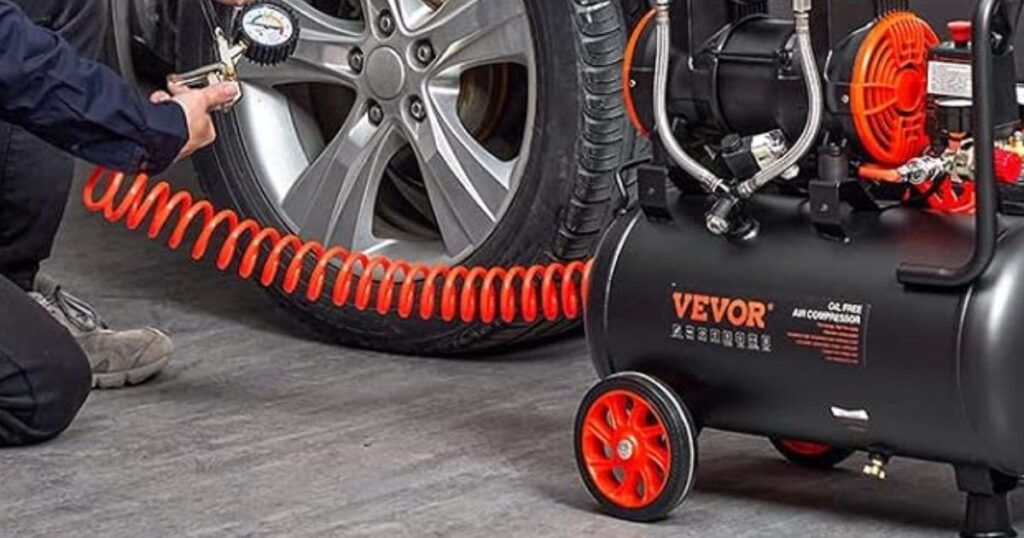
| Tyre inflation | ~1–2 CFM, intermittent | Comfortable |
| Framing nailer | ~2.2 CFM, intermittent | Fine at a working pace |
| Blow gun and cleaning | ~2–4 CFM, bursts | Fine in bursts |
| 3/8 in air ratchet | ~3–4 CFM, continuous | Marginal |
| 1/2 in impact wrench | ~4–5 CFM, continuous | No |
| Die grinder | ~5–8 CFM, continuous | No |
| Orbital sander | ~6–10 CFM, continuous | No |
| HVLP spray gun | ~4–12 CFM, continuous | Mostly no |
The spray painting claim needs qualifying
VEVOR lists spray painting among the intended uses, on both its own page and the Amazon listing. That deserves a caveat rather than a flat contradiction.
A conventional HVLP gun spraying a panel wants continuous air well above 3.35 CFM, and this compressor will not hold pressure through that. A small detail or touch-up gun, used in short passes with recovery time, is a different matter and is within reach. So: touch-up work yes, refinishing a car door no.
If spraying is the actual reason you are buying, an airless sprayer sidesteps the compressor question entirely. We went through that trade in our VEVOR airless paint sprayer review, which runs on its own pump and needs no air at all.
70 dB, and the number that is missing from it
This is the machine’s strongest claim. Typical oil-free compressors in this size run somewhere in the high seventies to high eighties on the dB scale, and because decibels are logarithmic, the gap between 70 and 85 is not a small improvement in comfort. It is the difference between a machine you can work beside and one that drives you out of the garage.
The caveat is that VEVOR does not state the distance at which 70 dB was measured, and sound level falls off sharply with distance. A figure at three metres and a figure at one metre are very different claims wearing the same number. Without the distance, it is not comparable to a competitor’s figure, and we would treat it as indicative rather than as a specification.
Oil-free: what you gain and what you give up
Oil-free is the right choice for this machine’s audience. No oil changes, no level checks, no risk of oil carryover contaminating an air line feeding a spray gun, and it can be tipped and carried without consequence.
The trade is lifespan and serviceability. Oil-free pumps run hotter and wear faster than oil-lubricated ones, and they generally cannot be rebuilt: when the pump is done, the compressor is done. On a $160 machine that is a reasonable bargain. On a machine you intend to run daily for years it is not, and that is the point at which a belt-driven cast iron pump starts making sense. We set out where that line sits in our air compressor and pneumatic tools buying guide.
What VEVOR does not publish
- Duty cycle. The most important omission. On an oil-free pump, which runs hot, the share of each hour the machine can actually work is a real constraint, and it is absent from the specification.
- Noise measurement distance. Covered above. It turns the headline figure into an indication.
- Tank recovery time. How long from cut-in to cut-out tells you how a nailer session will actually feel. Not stated.
- Tank drain and material. Every tank accumulates condensate and needs draining. The drain arrangement is not described.
One published figure looks wrong rather than missing. The specification gives a working temperature range starting at −59°F, which is implausible for any compressor and reads like a conversion error. We would not rely on it, and it is worth asking VEVOR directly if you are working anywhere genuinely cold.
Who it suits
Trim carpenters, DIY builders and anyone whose air tools are nailers. This is the use case the machine is genuinely built for. Brad, finish and framing nailers all sit comfortably inside 3.35 CFM, the tank is big enough that the pump is not cycling constantly, and 70 dB matters when you are working in a finished room.
Home garages doing tyres, inflation and blow-down. Comfortably within range, and the quiet running is worth more than the extra CFM you are not using.
Anyone who values quiet over capacity. If the compressor lives where people are, this is the trade worth making.
Who should buy something else
Anyone planning to run air-hungry tools. Impact wrenches, die grinders, orbital sanders and full-size spray guns need roughly double this delivery. Buying this and hoping is the most expensive mistake in the category, because the answer is a second compressor.
Daily commercial use. An unrebuildable oil-free pump with a one-year warranty and no published duty cycle is not a machine to build a business around. That is a belt-driven, oil-lubricated purchase.
Anyone without a spare circuit. At 12.1 amps running, this needs a circuit to itself.
Tools Soko verdict
No score, because we have not run it. What the published figures support is a narrower judgement.
At the $159.90 VEVOR listed on 7 September 2026 this is a well-matched machine for nailing and inflation, and the 70 dB claim is the reason to choose it over a cheaper pancake compressor rather than the horsepower figure printed next to it. The 6.3 gallon tank is a sensible pairing with 3.35 CFM: enough buffer for intermittent work without pretending to be a shop compressor.
The gaps are the ones this whole category shares. No duty cycle, no measurement distance on the noise figure, a one-year warranty and a pump nobody can rebuild. None of that is disqualifying at this price. All of it matters if you were planning to ask more of the machine than nailing.
Buy it for nailers. Do not buy it for grinders, and do not buy it because it says 2 HP.
Worth checking both. VEVOR showed this out of stock on its own site while writing, and the two retailers price independently.
If the machine you already own is tripping a breaker rather than simply drawing close to one, we work through the diagnosis separately in why an air compressor keeps tripping the breaker — starting with the one test that tells you whether the fault is electrical or a stuck unloader valve.
For the demand figures across the whole range of air tools, rather than just the ones this machine suits, see CFM explained: what every air tool actually needs.
If you have not settled on a size yet, what size air compressor do I need works through where this class of machine sits and what the next step up buys you.
If an oil-free machine like this one stops delivering, why an air compressor will not build pressure covers the diagnosis and, more importantly, whether the pump is the kind that can be repaired at all.
Frequently asked questions
Is 3.35 CFM enough for an impact wrench?
Not for a 1/2 inch impact wrench, which typically wants 4 to 5 CFM continuously. You will get a few seconds of work from the tank and then the tool will slow as pressure drops. A 3/8 inch air ratchet at 3 to 4 CFM is marginal and will work in short bursts. Nailers are the tools this compressor genuinely suits.
Is this really a 2 HP compressor?
The motor is 1450 watts, which is about 1.94 horsepower of electrical input. Actual shaft output is lower once motor losses are accounted for. The practice is standard across budget compressors rather than unique to VEVOR, which is why horsepower is useless for comparison. Compare CFM at 90 PSI instead.
What circuit does it need?
Roughly 12.1 amps running at 120 volts, which leaves almost no headroom on a 15 amp circuit once start-up surge is included. Give it a dedicated circuit, prefer 20 amps, and avoid sharing with anything else. If you use an extension lead, keep it short and heavy gauge.
Can it run a spray gun?
A small detail or touch-up gun used in short passes, yes. A conventional HVLP gun spraying panels wants continuous air well above 3.35 CFM and this will not hold pressure through it. If spraying is the main goal, an airless sprayer avoids the compressor question altogether.
Is 70 dB actually quiet for a compressor?
Yes, meaningfully so. Comparable oil-free machines commonly sit in the high seventies to high eighties, and because the decibel scale is logarithmic that gap is large in practice. The caveat is that VEVOR does not state the measurement distance, so treat the number as indicative rather than as a directly comparable specification.
Does an oil-free compressor last?
Less long than an oil-lubricated one, and it generally cannot be rebuilt. Oil-free pumps run hotter and wear faster, so when the pump fails the machine is finished. For intermittent home and trim work that is a fair trade at this price. For daily commercial use, a belt-driven cast iron pump is the better long-term buy.
How big a tank do I actually need?
Tank size buys burst duration, not sustained output. For intermittent tools like nailers, 6 gallons paired with 3.35 CFM is a sensible match. For continuous-draw tools, a larger tank only delays the moment the pump falls behind, so the fix is more CFM rather than more gallons.
Sizing theory, compressor classes and the tools worth owning first are covered in our air compressor buying guide. On buying from an unfamiliar seller, see how to choose a reliable retailer, and for trade purchasing, what contractors should look for in a supplier.