
Almost everyone sizes a compressor by tank. The tank is the least important number on the machine, and picking by gallons is how people end up buying twice.
This guide is built from published compressor and air tool specifications and from how piston compressors are engineered. It is not a bench test. See how we work.
Why you can trust us. Tools Soko earns a commission when you buy through links on this page. It never changes what we recommend, and it never changes the price you pay. As an Amazon Associate we earn from qualifying purchases.
Sizing runs in one direction: from the hungriest tool you will actually put on the hose, back to the machine that can feed it. Everything else follows from that, and nothing about it starts with the tank.
Start here
Three questions decide the machine.
- What is the hungriest tool you will genuinely run? Not aspirationally. The one that will be connected.
- Does it draw continuously or intermittently? A nailer takes a gulp and stops. A sander does not. We worked through why that distinction governs everything in CFM explained.
- Will more than one person be working at once? If so, the demands add. Air does not queue.
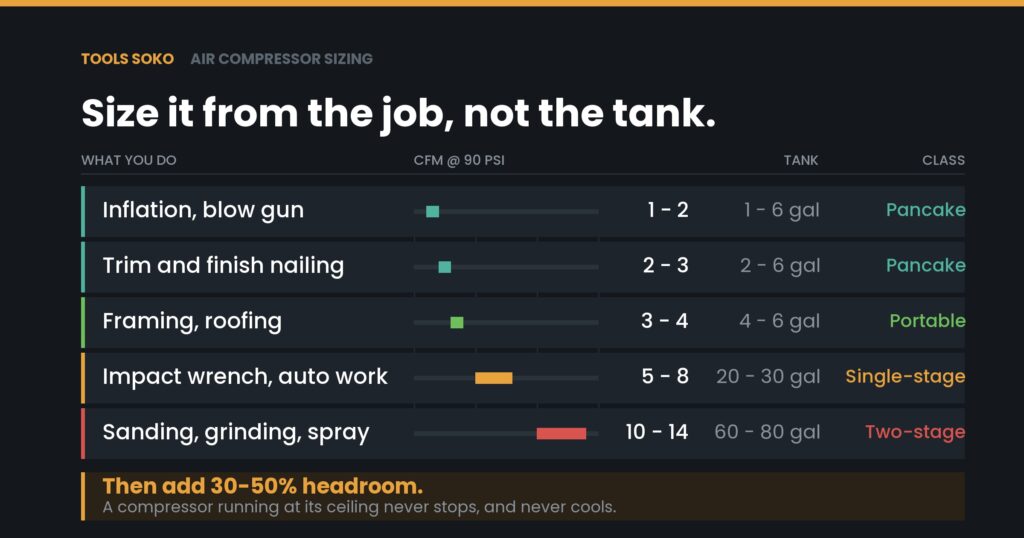
Answer those and the table below gives you the machine class. Then add 30 to 50 per cent headroom, because a compressor running at its rated ceiling never stops, and a pump that never stops never cools.
Size by what you actually do
| What you do | CFM at 90 PSI | Tank | Class |
|---|---|---|---|
| Tyres, inflation, blow gun | 1–2 | 1–6 gal | Pancake, oil-free |
| Trim, finish and brad nailing | 2–3 | 2–6 gal | Pancake or hotdog |
| Framing and roofing nailers | 3–4 | 4–6 gal | Portable twin-stack |
| Impact wrench, air ratchet, general auto | 5–8 | 20–30 gal | Single-stage vertical |
| Continuous sanding, grinding, spraying | 10–14 | 60–80 gal | Two-stage |
| Two people working simultaneously | Sum, then +40% | 80 gal | Two-stage |
| Sandblasting | 10–20+ | 80 gal+ | Two-stage |
What the tank actually does
A tank is a buffer, not a supply. It cannot create air, only lend it faster than the pump makes it.
For intermittent tools that is exactly right, and it is why a six gallon tank runs a nailer indefinitely. For continuous tools the tank only sets how long you get before reality arrives, and a bigger one just postpones it.
Where tank size genuinely earns money is cycle frequency. A larger tank means the motor starts less often, and every start is an inrush current spike and a moment of wear. Fewer starts is a longer-lived machine and, incidentally, one less likely to be tripping a breaker on start-up.
So the honest rule: choose CFM to match the tool, then choose tank size to control how often the motor cycles. In that order, never the reverse.
Single-stage or two-stage
This is the real dividing line in the category, and it is barely mentioned on consumer listings.
A single-stage pump compresses air once and sends it to the tank. Compression generates heat, and heat is what limits it: single-stage machines typically top out around 120 to 135 PSI because going higher makes them run too hot to sustain.
A two-stage pump compresses twice, passing the air through an intercooler in between. Removing that heat means the second stage is compressing cooler, denser air, which takes less work. The result is roughly 150 to 175 PSI, discharge temperatures materially lower, and more CFM delivered per horsepower once you are above about 120 PSI.
| Single-stage | Two-stage | |
|---|---|---|
| Typical max pressure | 120–135 PSI | 150–175 PSI |
| Duty | Intermittent, commonly around 50% | Built for sustained running |
| Running temperature | Higher | Materially cooler |
| Efficiency above 120 PSI | Falls away | More CFM per horsepower |
| Expected service life | Shorter | Roughly double, under load |
| Suits | Home, trim, occasional auto | Shops, continuous tools, two users |
There is a second benefit to the higher pressure that people miss. A tank storing air at 175 PSI holds substantially more usable air than the same tank at 135 PSI, so a two-stage machine gets more work out of every gallon before the pump has to catch up.
If your honest answer to question one was a sander, a grinder or a spray gun, you are shopping for a two-stage machine and the small portable ones were never in contention.
Duty cycle: the specification nobody prints
Duty cycle is the share of a period a compressor can run before it needs to cool. A 50 per cent duty cycle means half an hour of running in every hour, and it is a hard limit rather than a suggestion.
Small oil-free compressors frequently do not publish one at all. That absence is itself informative: assume around 50 per cent unless told otherwise, and treat any machine that will not state a figure as unsuitable for sustained work.
Oil-free pumps run hotter than oil-lubricated ones by design, which is why they trip thermal overloads sooner and wear faster. That trade is reasonable on a machine you use in bursts and unreasonable on one you expect to run all afternoon. Our air compressor buying guide covers where that line sits and what oil-lubricated buys you.
120V or 240V
The supply sets a ceiling on the machine long before your budget does.
A 120V circuit realistically supports a compressor drawing up to around 12 to 15 amps, which caps you in the region of 4 to 5 CFM. That covers everything in the first three rows of the table above and nothing below them. A machine at that ceiling wants a circuit to itself, as we worked through in the VEVOR 6.3 gallon review, where a 1450 W motor draws 12.1 amps running.
Anything delivering 10 CFM or more is a 240V machine, and often a hardwired one. Establish what 240V capacity is available before you shop, because discovering there is none, after the pallet arrives, turns a compressor purchase into an electrical project.
Portable or stationary
Once a compressor passes roughly 30 gallons it stops being something you move and starts being something you install. That is not only weight: stationary machines are usually 240V, often hardwired, and frequently plumbed into fixed airlines rather than a hose reel.
The question worth asking early is whether the air needs to move or the tool does. Running a long air hose from a fixed compressor is almost always better than dragging the compressor, and it is certainly better than running a long power cord to it.
Three ways people get this wrong
Buying on tank size. A 30 gallon tank behind a weak pump is worse than a 20 gallon tank behind a strong one, and it looks like more machine on the shelf.
Sizing for the tool you might buy. Buy for the work you do now. Air tools are cheap and compressors are not, so it is easier to add a tool later than to discover the compressor cannot feed it.
Ignoring headroom. A compressor exactly matched to its tool runs continuously, gets hot, and wears out early. The 30 to 50 per cent margin is not padding, it is what lets the machine cycle and cool.
If an existing compressor has stopped reaching its rated pressure, that is a fault rather than a sizing problem. why an air compressor will not build pressure separates the two.
Frequently asked questions
What size air compressor do I need for a nail gun?
Far less than most people buy. Brad and finish nailers need under 1 CFM at 90 PSI, and even a framing nailer sits around 2.2. A 2 to 6 gallon pancake or hotdog compressor delivering 3 CFM covers all of them comfortably, because nailing is intermittent and the tank recovers between shots.
What size compressor runs an impact wrench?
A 1/2 inch impact wrench wants 4 to 5 CFM continuously, so with headroom you are looking for 6 to 8 CFM at 90 PSI and a 20 to 30 gallon tank. That is a single-stage vertical machine, not a portable pancake. For occasional wheel nuts people manage in short bursts on less, but it is working outside the machine’s design.
Is a bigger tank better?
Only for cycle frequency. The tank stores air, the pump makes it, and once the tank is drained your output is whatever the pump delivers regardless of size. A bigger tank does mean fewer motor starts, which means less inrush and less wear, so it helps longevity rather than capability.
Do I need a two-stage compressor?
If you will run sanders, grinders, spray guns or two tools at once, yes. Two-stage machines compress twice with an intercooler between stages, reach 150 to 175 PSI against a single-stage ceiling of about 120 to 135, run cooler, deliver more CFM per horsepower above 120 PSI and last considerably longer under sustained load. For nailing and inflation they are more machine than the job needs.
What duty cycle should I look for?
For intermittent work, 50 per cent is fine and is what most portable machines offer. For anything sustained you want a machine rated for continuous duty, which in practice means two-stage and oil-lubricated. If a manufacturer does not publish a duty cycle at all, assume around 50 per cent and treat the omission as a signal about the machine’s intended use.
Can I run a compressor on a normal household socket?
Up to a point. A 120V circuit supports roughly 12 to 15 amps, which caps you around 4 to 5 CFM — enough for nailing, inflation and light work. Anything delivering 10 CFM or more needs 240V and often a hardwired supply, so confirm what capacity you have before shopping rather than after delivery.
How much headroom should I add?
Thirty to fifty per cent above the demand of your hungriest tool. A compressor sized exactly to its load runs continuously, which means it never cools, wears faster and is more likely to trip a thermal overload. The margin is what lets the machine cycle, and it costs less than replacing a pump.
Part of our air and pneumatics series. For what the numbers mean, CFM explained. For a machine at the portable end, the VEVOR 6.3 gallon review. And if yours keeps cutting out, why an air compressor trips the breaker.