
One question splits this problem in half. Does the compressor trip when you start it with an empty tank, or only when it restarts with pressure already in the tank?
This article is built from published manufacturer specifications, technical documentation and the reported experience of people who own the equipment. Nothing here has been tested by Tools Soko and nothing carries a score. See how we work.
If it starts fine from empty but trips on the restart, the fault is almost always mechanical and cheap: the unloader valve. If it trips from empty too, the problem is electrical and lives in the circuit, the cord or the motor.
That single test skips most of the guesswork, and it is the one thing most troubleshooting lists leave out. Everything below is built from how induction motors and thermal breakers actually behave, with the arithmetic shown so you can run it on your own machine.
Before anything else. Never fit a larger breaker to stop a compressor tripping. The breaker protects the wiring in your wall, not the compressor. Upsizing it removes the protection and leaves the cable to overheat instead. If a circuit cannot carry the load, the fix is a correctly sized circuit installed by a qualified electrician, not a bigger fuse.
The two-minute diagnostic
| What you observe | Most likely cause | Where to look |
|---|---|---|
| Starts fine from empty, trips only on restart | Unloader valve stuck closed | Pressure switch, unloader line |
| Trips instantly, every time, even from empty | Circuit too small, or shared | Breaker rating, what else is on it |
| Motor hums, does not spin, then trips | Start capacitor, or seized pump | Capacitor, pump turns by hand |
| Runs for minutes, then trips | Thermal overload, not the breaker | Motor reset button, ventilation |
| Only trips on an extension lead | Voltage drop | Cord gauge and length |
| Started recently, nothing else changed | Tired breaker or failing capacitor | Both are consumables |
1. The unloader valve, and the sound it should make
This is the most common mechanical cause and the one worth checking first, because the test is free and takes five seconds.
When a compressor reaches cut-out pressure and stops, air is still trapped above the piston and in the discharge line. The unloader valve vents that trapped air so the motor next starts against nothing. You hear it as a short psst a second or two after the motor stops.
The test: let the compressor fill and cut out. Listen. If there is no brief hiss of air, the unloader is suspect.
When it fails to vent, the motor has to restart against full pump-head pressure. An induction motor that cannot get up to speed sits at locked-rotor current, which is commonly five to ten times its running draw, and it stays there until something gives. Usually that is the breaker, sometimes the motor’s own thermal overload.
The unloader is normally part of the pressure switch assembly, and it is an inexpensive part. A leaking check valve produces the same symptom by letting tank pressure bleed back into the pump head, so if the unloader is venting and the fault persists, that is the next thing to look at.
2. The circuit was never big enough
Run the arithmetic before you assume a fault, because on a lot of compressors there is nothing wrong at all.
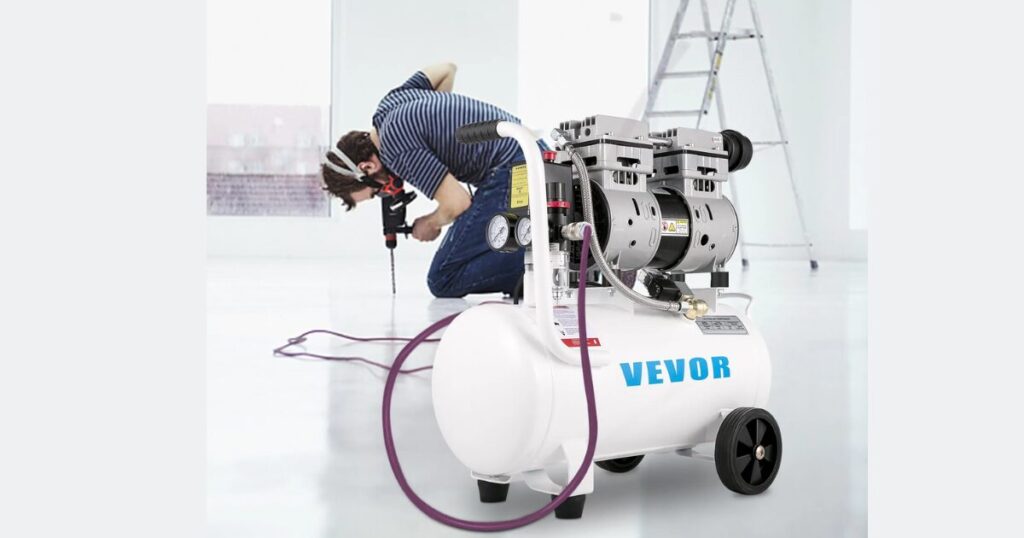
Take the motor’s wattage from the plate and divide by supply voltage. A 1450 W motor on 120 V draws roughly 12.1 amps running. On a 15 amp circuit that leaves under three amps of headroom before anything else is plugged in, and the compressor we worked through in our VEVOR 6.3 gallon compressor review sits exactly there.
Then add the start. Induction motors draw locked-rotor current for the fraction of a second before they come up to speed, typically five to eight times running current. The motor plate often gives this as LRA. A standard thermal-magnetic breaker tolerates a brief surge, but the margin is not generous, and it shrinks as the breaker ages.
So the practical rule: a compressor of this size wants a circuit to itself. Not a circuit that is usually free, one that has nothing else on it. A shop vac, a heater, a kettle in the next room on the same ring, a second person plugging in a grinder — any of those is enough.
Find out what it actually draws
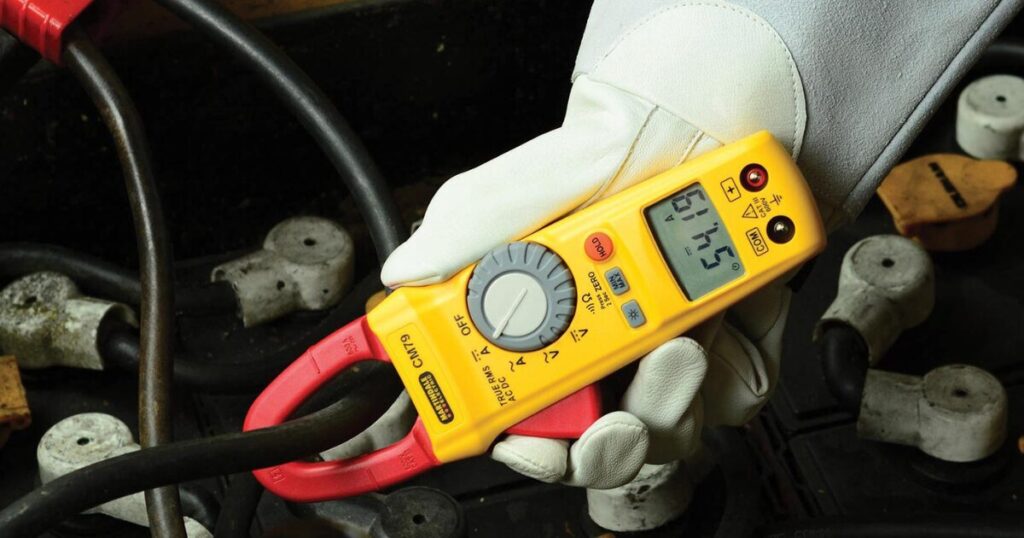
If you want the real number rather than the plate figure, a clamp meter around the live conductor gives you running amps directly. Anything materially above the calculated figure points at a motor or mechanical problem rather than an undersized circuit. Our guide to the tools a professional electrician carries covers what to look for in one.
3. The extension cord is the problem more often than the compressor
This one is counter-intuitive and it catches almost everybody.
A motor is closer to a constant-power device than a constant-current one. Put it on a long thin cord, the voltage at the motor sags, and to deliver the same mechanical work the motor draws more current, not less. More current through a thin cord means more heat, more voltage drop, and a motor that struggles to reach speed — which is exactly the condition that trips a breaker or cooks a winding.
The tell is simple: it runs fine plugged straight into the wall and trips on the cord.
| Length | Minimum for a 12 A tool | Notes |
|---|---|---|
| Up to 25 ft | 14 AWG | 12 AWG is better and costs little more |
| 25–50 ft | 12 AWG | The practical default for a compressor |
| 50–100 ft | 10 AWG | Heavy, expensive, and still a compromise |
| Over 100 ft | — | Move the compressor, not the air |
The better answer on any job is to run a long air hose from a compressor plugged into the wall, rather than a long power cord to a compressor parked next to you. Air loses very little over distance. Electricity does.
4. Breaker or thermal overload? They are not the same fault
Before chasing the circuit, establish which device actually stopped the machine.
- The breaker in your panel tripped. The circuit was asked for more current than it is rated to carry. Look at load, cord and starting current.
- The motor’s own overload tripped. Most compressors have a reset button on the motor housing. This is a heat fault: the motor got too hot. Look at ventilation, ambient temperature, duty cycle and a restricted air intake filter.
A machine that runs for several minutes and then stops is usually thermal. A machine that stops the instant the motor kicks in is usually electrical. Oil-free pumps run hotter than oil-lubricated ones by design, so thermal trips on a hot day are more common on them, and a duty cycle nobody published is often the underlying reason.
5. The start capacitor
Single-phase induction motors use a capacitor to get moving. When it weakens, the motor cannot develop enough starting torque, so it sits humming at locked-rotor current instead of spinning up.
The symptom is distinctive: a loud hum, no rotation, and a trip a second or two later. Sometimes a nudge to the pulley by hand gets it going, which is a strong indicator and also a good way to lose a finger — do not do it with the machine live.
Capacitors store charge after disconnection and can hold a dangerous voltage. This is a job for someone who knows how to discharge one safely.
6. The breaker itself is tired
Thermal-magnetic breakers are mechanical devices and they weaken with repeated tripping. A breaker that has protected the circuit through fifty compressor starts may begin to trip at a current it once tolerated.
The signal is a fault that appeared gradually with nothing else changed: same compressor, same cord, same circuit, and it started tripping. Replacement is an electrician’s job, and it is a like-for-like replacement at the same rating, never a larger one.
Where this stops being a DIY job
Checking the unloader, listening for the vent, reading the motor plate, swapping an extension cord, cleaning an intake filter and pressing a thermal reset are all reasonable things to do yourself.
Opening the motor terminal box, testing or replacing a capacitor, changing a breaker, or adding a circuit are not. Call a qualified electrician, and if the honest answer is that your panel has no capacity left, that is a real finding rather than a sales pitch — the same constraint that comes up again and again when sizing supplies in our air compressor buying guide.
If the machine is not tripping so much as failing to keep up, that is a sizing problem rather than an electrical one. CFM explained: what every air tool actually needs works through what your tools actually demand.
If the machine simply cannot keep up rather than cutting out, that is a sizing problem. what size air compressor do I need covers matching the compressor to the work.
If the machine runs happily but never reaches cut-out, that is the other common failure and a different diagnosis entirely. why an air compressor will not build pressure works through it with three tests you can do without tools.
Frequently asked questions
Why does my air compressor only trip the breaker on restart?
Almost certainly the unloader valve. When the compressor cuts out, that valve should vent the air trapped above the piston, so the motor next starts against no pressure. If it does not vent, the motor restarts against full pump-head pressure, cannot come up to speed, and sits at locked-rotor current until the breaker trips. Listen for a short hiss a second or two after cut-out; no hiss means a suspect unloader.
Can I just fit a bigger breaker?
No. The breaker is sized to protect the cable in the wall, not the appliance. A larger breaker lets the cable carry current it was never rated for, and the failure mode is an overheating conductor inside a wall rather than a tripped switch you can see. If the circuit genuinely cannot carry the load, the fix is a correctly sized circuit installed by a qualified electrician.
How many amps does an air compressor draw on startup?
Running current is motor watts divided by supply voltage — a 1450 W motor on 120 V draws about 12.1 amps. Starting current is far higher, typically five to eight times running current for a fraction of a second, and the motor plate may give it as LRA, or locked rotor amps. That brief surge is what a breaker has to tolerate, and the margin narrows as a breaker ages.
Why does it trip only when I use an extension cord?
Voltage drop. A motor works closer to constant power than constant current, so when a long or thin cord makes the voltage sag, the motor draws more current to do the same work. That extra current makes more heat and more drop. Use 12 AWG for runs to 50 feet and 10 AWG beyond, or better still leave the compressor at the wall and run a long air hose instead.
My compressor hums but does not start. What is that?
A hum with no rotation followed by a trip usually means the motor cannot develop starting torque. The common causes are a failing start capacitor and a pump that has seized or is being asked to start against pressure. Capacitors hold a dangerous charge after disconnection, so testing or replacing one is work for someone qualified.
It runs for a few minutes then stops. Is that the breaker?
Usually not. That pattern points at the motor’s own thermal overload rather than the panel breaker — check for a reset button on the motor housing. It is a heat fault, so look at ventilation, ambient temperature, a clogged intake filter, and the possibility that the machine is simply being run harder than its duty cycle allows. Oil-free pumps run hotter and hit this sooner.
Does a bigger tank help?
Not with tripping. A bigger tank means the motor starts less often, which can mask the symptom, but every start still draws the same inrush and the underlying fault is unchanged. If anything a larger tank runs the motor for longer per cycle, which makes a thermal trip more likely rather than less.
Part of our air and pneumatics series. Sizing a machine in the first place is covered in the air compressor buying guide, and what a given CFM figure will actually run is worked through in our VEVOR 6.3 gallon compressor review.