
VEVOR sells this sprayer in five different wattages under near-identical titles. Get the wrong one and you lose 300 PSI, a third of the flow rate and half the hose.
This review is built from VEVOR’s published specifications and from 734 owner reviews on VEVOR’s own product page. This machine has not been on the Tools Soko bench, so it carries no score. We do not put a number on a tool we have not used.
Why you can trust us. Tools Soko earns a commission when you buy through links on this page. It never changes what we recommend, and it never changes the price you pay. As an Amazon Associate we earn from qualifying purchases.
The arithmetic that sells airless sprayers is simple. A roller moves paint at a rate set by your arm. A pump moving 0.47 gallons a minute does not care how tired you are, and VEVOR’s claim of six times faster than a roller is, if anything, conservative on open exterior wall.
The arithmetic that should worry you is different. An airless sprayer is a piston pump pushing paint to 3,300 PSI, and everything that goes wrong with cheap ones goes wrong in the same three places: the packings that seal the piston, the tip that wears into an oval, and the fifteen minutes of cleanup somebody skipped.
First, check which VEVOR you are looking at
This matters before anything else. VEVOR lists this stand airless sprayer at 650W, 750W, 900W, 950W and 1500W, and the 900W model comes in two versions, with the cart and without. The product titles are almost identical and the listings sit next to each other.
Everything below refers to model 190C-L, SKU ZSSPTJ900W04UXQUL001V1, the wheeled 900W version. Read the wattage on the listing in front of you before you pay, because the 750W machine is a materially different tool at a similar-looking price.
What is the VEVOR 190C-L?
An entry-level electric airless sprayer aimed at homeowners painting a whole house, and at small contractors who cannot justify a Graco. The pump draws directly from a paint bucket through a flexible suction tube, so there is no cup to refill and no transfer step.
VEVOR positions it for “large-scale projects like townhouses and factory buildings”. That is the manufacturer’s framing, and it is worth reading as marketing rather than as a duty rating. VEVOR publishes no duty cycle for this machine, which is a real gap we come back to.
VEVOR 190C-L specifications
| Brand / model | VEVOR 190C-L |
| SKU | ZSSPTJ900W04UXQUL001V1 |
| Motor | 900 W |
| Maximum pressure | 3,300 PSI |
| Flow rate | 0.47 GPM (1.78 L/min) |
| Hose | 50 ft (15.24 m) high pressure |
| Spray gun | Model 818 |
| Nozzles supplied | 317, 417, 515, 517, 519 |
| Extension pole | 18.9 in (480 mm) |
| Suction | Direct draw, 1 to 5 gallon buckets |
| Frame | Q235 steel, ABS shell |
| Weight | 30.42 lb (13.8 kg) |
| Dimensions | 16.54 × 15.35 × 35.04 in |
| Warranty | 12 months |
| Price, VEVOR list | $250.90 (August 2026) |
| Price, Amazon | $218.37 (checked 18 September 2026) |
| Owner rating | 4.7 / 5 across 734 reviews |
The missing figures are worth naming. The inclusion of a 519 tip implies the pump will run a 0.019 inch orifice, but VEVOR does not state a maximum, and that is the specification deciding whether this machine pushes heavy exterior coatings all day.
Prices and stock, checked 18 September 2026. Amazon listed the wheeled 900W at $218.37 and the portable at $167.87, both below VEVOR’s August list prices, and both showed as currently unavailable when we looked. Treat that stock reading as a prompt to check rather than as a fact, because availability on these listings changes often and varies by region. VEVOR’s own site blocks automated checks, so its current price could not be confirmed here. Check both before you buy; they move independently.
What stands out
3,300 PSI is the number that matters, not the wattage
Wattage tells you what the motor draws. Pressure tells you what the paint does when it leaves the tip.
Airless spraying works by forcing paint through a small orifice hard enough that it shatters into droplets on its own, with no air assist. Below roughly 2,000 PSI, unthinned latex does not atomise properly. You get a coarse, spattered finish that people usually blame on the sprayer when the real problem is pressure, and plenty of sub-$200 machines sit at 2,000 to 2,500 PSI for exactly that reason.
3,300 PSI clears that bar with room to spare. It means unthinned interior latex sprays properly, and it means the machine is not working at the top of its range on the thicker stuff. At 900W on a 120V circuit the draw is roughly 7.5 amps, so any household outlet handles it, and a long extension cord will not cause the voltage drop that troubles bigger machines.
0.47 GPM, translated into a working day
Flow rate is the figure people skip, and it is the one that predicts how the day actually goes. 0.47 GPM empties a five-gallon bucket in a shade under eleven minutes of continuous trigger time.
Nobody sprays continuously. Call it a bucket every twenty-five to thirty-five minutes of real work, including moving, cutting in and re-aiming. That is roughly half the output of a contractor machine and roughly double what a handheld cup sprayer manages before refilling. A genuine mid-point, and it suits a house rather than a subdivision.
The 50-foot hose is quietly the best thing here
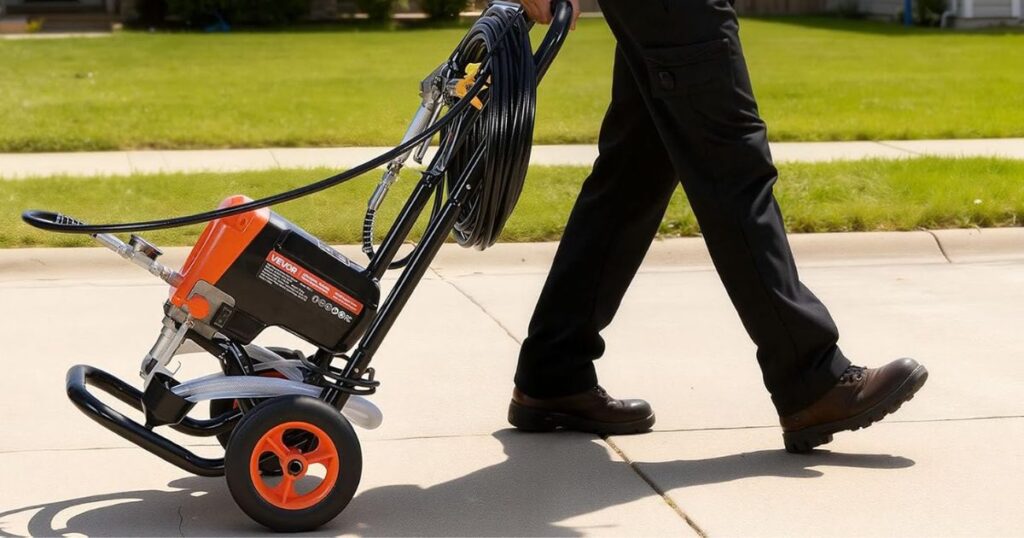
Entry-level sprayers usually ship with 25 feet of hose. This one ships with fifty, and it changes how you work more than any other item in the box. The pump stays in one place while you paint a whole room, or reaches a second storey from ground level, or covers a long exterior wall without stopping.
It is also the item that costs real money to add later. A 50 ft airless hose is not a trivial accessory purchase, and having it in the box is a meaningful part of what the $250 buys.
Five tips, and what the numbers on them mean
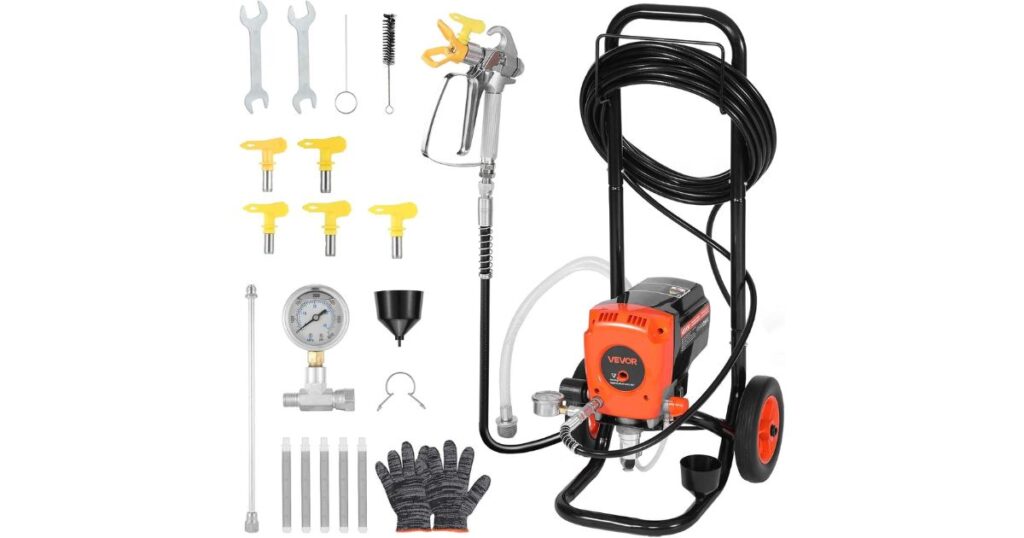
This is the part most first-time buyers get wrong, and it is the most useful thing in this review. Airless tip numbering is a three-digit code, and it is not arbitrary.
Double the first digit to get the fan width in inches at 12 inches from the surface. The last two digits are the orifice size in thousandths of an inch.
| Tip | Fan width | Orifice | What it is for |
|---|---|---|---|
| 317 | 6 in | 0.017 in | Narrow work, fences, railings, trim |
| 417 | 8 in | 0.017 in | Doors, cabinets, medium surfaces |
| 515 | 10 in | 0.015 in | Stains, lacquer, thinner coatings |
| 517 | 10 in | 0.017 in | Interior and exterior latex, the default |
| 519 | 10 in | 0.019 in | Heavy exterior and thick coatings |
The orifice governs how much paint comes out and how thick a material the tip will pass. The fan width governs how fast you cover ground and how much overspray you create.
Two practical consequences follow. If your finish is spattering, the usual culprit is an orifice too large for the material, or pressure set too low, not a defective machine. One owner review on VEVOR’s page describes exactly this, resolved by changing tip size. And tips are consumables: the orifice wears oval with use, the fan pattern degrades into a fingered mess, and no amount of pressure fixes it. Budget for replacements the way you budget for grinder discs.
The cart costs $24 to $50, depending on where you buy
VEVOR sells the same 900W pump without the cart, model 190C, at 22.88 lb against 30.42 lb for the wheeled version. On VEVOR’s own August list prices, $226.90 against $250.90, the cart adds about 7.5 lb and $24. On Amazon, checked 18 September 2026, the gap is wider: $167.87 without the cart against $218.37 with it, or about $50.
For a machine you reposition constantly around a house, with a five-gallon bucket following it, that is a straightforward yes. The weight only counts against you if you are carrying it up scaffolding, in which case buy the portable one deliberately.
Who is it for?
Someone painting a whole house, inside or out, who has been quoted for the job and worked out that the sprayer costs less than the quote.
It also suits a small contractor doing occasional spray work, on fences, sheds, cabinet refinishing and rental turnarounds, where a Graco cannot be justified by volume but a cup sprayer is too slow to bill against. The direct-draw suction tube is what makes those jobs practical. Anything spraying from a cup becomes an exercise in refilling long before the wall is finished.
Who might want something else?
If you spray for a living, every day. VEVOR publishes no duty cycle, the warranty is twelve months, and the owner reviews cover early performance rather than long-term durability. A Graco or Titan costs three to four times as much and is bought specifically for the repair network and the packing kits. That is a different purchase from this one.
If your job is small. For a single room, a door, or a set of shelves, this is more setup and more cleanup than the work justifies. Fifteen minutes of flushing to paint a bedroom door is a bad trade, and a brush wins.
If you cannot control overspray. Airless atomisation is aggressive, and 3,300 PSI through a 10-inch fan puts paint on everything you have not masked. Occupied rooms, cars nearby, a neighbour’s fence within range are all reasons to roll instead. If your work is decorative rather than broad-area coverage, our guide to faux finishing tools covers what actually suits that job.
What to consider before buying
Cleanup is the actual job
An airless sprayer left with paint in it is usually finished. Dried latex in the pump, the hose and the filters is not a maintenance issue, it is a replacement.
Flushing means running solvent or water through the entire system, pump, fifty feet of hose, gun and filters, until it runs clean, then relieving pressure and storing with pump conserver. Expect fifteen to twenty-five minutes every single time. Note the trade too: the 50-foot hose that makes the work easier makes the cleanup longer, because there is more of it to clear.
VEVOR’s answer is a detachable pump body and a supplied cleaning brush, which genuinely helps. Owner reviews describe cleaning as straightforward, though some also flag it as effort. Both are true. It is straightforward, and it is not optional.
What owners actually report
Across 734 reviews VEVOR’s page shows 4.7 out of 5, with 84% at five stars and 4% at one star. That 4% is worth reading rather than dismissing.
Recurring praise: value for the money, ease of use, and professional-looking results on cabinets and fences. Recurring problems are narrower than you might expect, being mostly incomplete shipments, including one owner reporting a missing hose, some dripping, and a learning curve around nozzle selection.
What is absent is as informative as what is present. There is no widespread pattern of clogging, pressure loss, or failure on thick material. There is also very little long-term durability data, because most reviews describe early use. Neither of those is a verdict. It is what the available evidence does and does not cover.
The 12-month warranty, read plainly
Twelve months is standard for the price class and short by contractor standards. On a pump, the parts that wear are packings and seals, and those are wear items rather than warranty items on any brand. The realistic question is whether VEVOR sells replacement packing kits for the 190C-L when you need them, and the product page does not answer it. Worth checking before you commit to heavy use.
How does it compare?
| 190C-L, with cart | 190C, portable | RP8626, 750W | |
|---|---|---|---|
| Motor | 900 W | 900 W | 750 W |
| Pressure | 3,300 PSI | 3,300 PSI | 3,000 PSI |
| Flow | 0.47 GPM | 0.47 GPM | 0.32 GPM |
| Hose | 50 ft | 50 ft | 25 ft |
| Weight | 30.42 lb | 22.88 lb | 19.6 lb |
| Cart | Yes | No | No |
| VEVOR list price, Aug 2026 | $250.90 | $226.90 | $166.90 |
| Amazon price, 18 Sep 2026 | $218.37 | $167.87 | $123.47 |
On a house, the 900W is the better buy. On occasional furniture and fence work, the 750W is enough machine and the saving is real.
Against Graco and Titan entry machines, we have not tested those against this one and will not pretend otherwise. The structural difference is not pressure, which is broadly comparable at the entry level, but serviceability: established packing kits, repair parts, and dealers who stock them. That is what the extra money buys, and whether it is worth buying depends entirely on how many gallons a year go through the machine.
Worth noting that a compressor and spray gun is a different route to the same finish, with different trade-offs on overspray and material. We covered that setup in our guide to air compressors and pneumatic tools.
Tools Soko verdict
No score, because we have not run this machine. What the specifications support is a narrower statement.
The two figures that decide whether an entry-level airless sprayer is worth owning are pressure high enough to atomise unthinned latex, and enough hose to work without constant repositioning. Both land on the right side here, and they land there at a price where most competitors compromise on one or the other.
The gaps are equally clear. No published duty cycle, no stated maximum tip size, a twelve-month warranty, and no long-term durability record in the owner reviews. For a homeowner painting their own house, none of those is likely to bite. For anyone spraying weekly, all four are the reason contractor machines cost what they do.
Buy it for a house. Do not buy it for a business without first confirming that replacement packings are available.
Worth pricing both. The two move independently, and the cheaper one is not consistently the same one.
What you will need alongside it
These are the items that decide whether the first day goes well.
- Spare tips, particularly a second 517. A worn tip is indistinguishable from a broken sprayer until you swap it.
- A respirator rated for paint spraying, not a dust mask. Atomised paint is a fine aerosol and you will be standing in it. Our jobsite PPE guide covers what people actually keep on.
- Masking film and tape, more than you think. Overspray travels.
- Pump conserver fluid for storage between jobs.
- A paint strainer. Skinned or lumpy paint blocks the tip mid-wall, and the filter cannot catch everything.
Weighing a compressor and spray gun instead? Our VEVOR 6.3 gallon air compressor review explains why a small compressor will not sustain a conventional HVLP gun, which is the usual reason people end up buying airless.
Considering a compressor and spray gun as the alternative? CFM explained: what every air tool actually needs explains why a conventional HVLP gun is one of the hungriest tools you can put on a hose.
Frequently asked questions
Can this sprayer handle unthinned latex paint?
At 3,300 PSI it has the pressure to atomise unthinned interior latex, and the included 517 and 519 tips are the right orifice sizes for it. Straining the paint first is still worth the two minutes, because a lump that reaches the tip stops the job.
What do the numbers on the nozzles mean?
Double the first digit for fan width in inches, and read the last two digits as the orifice size in thousandths of an inch. A 517 sprays a 10-inch fan through a 0.017 inch orifice. Larger orifice means more paint and thicker material; wider fan means faster coverage and more overspray.
Which nozzle should I start with?
517 for walls, interior or exterior. 515 for cabinets, trim and thinner coatings like stain or lacquer. 519 when the coating is heavy enough to struggle through a 517. The 317 and 417 are for narrow work where a 10-inch fan would waste paint.
How long does cleaning take?
Budget fifteen to twenty-five minutes, every time. The 50-foot hose is an advantage while spraying and a disadvantage while flushing, because there is more of it to clear. Paint left in the pump overnight is how these machines die.
Is the cart version worth the extra money?
For $24 and 7.5 lb, yes, if you are moving around a house with a bucket in tow. Buy the portable 190C instead if you will be carrying the machine up ladders or scaffolding, where the cart is dead weight.
What is the difference between the 750W and 900W models?
The 900W runs 3,300 PSI against 3,000, moves 0.47 GPM against 0.32, and ships with 50 feet of hose against 25. It is heavier and roughly $84 more. Check the wattage on any listing carefully, because VEVOR sells several variants under very similar titles.
Can I use it for stain on a fence?
Yes, and owner reviews specifically mention fence staining as a strong use case. Stain is thinner than paint, so start with the 515 tip and lower the pressure until the fan is even without spattering.