
A homeowner’s tool kit does not need to be big. It needs to be the right twenty tools, bought to the right specification, so that the first time a cabinet door drops or a tap starts dripping you already own what fixes it. Here is each one, what separates a good example from a bad one, and a named pick that meets the spec.
This guide started from a list of twenty homeowner essentials that has been circulating on X. The tool choices are sound; the detail underneath them is ours. Every named product was checked against its manufacturer listing on Amazon on 14 September 2026, and the specifications quoted come from those listings. Tools Soko has not tested these tools. See how we work.
Why you can trust us. Tools Soko earns a commission when you buy through links on this page. It never changes what we recommend, and it never changes the price you pay. As an Amazon Associate we earn from qualifying purchases.
One note for readers outside North America before you start. The links go to Amazon US, and two of the picks below are built for 120-volt supplies: the charger in the drill kit and the plug-in outlet tester. Both are flagged where they appear.
The twenty at a glance
| # | Tool | The specification that matters | Named pick |
|---|---|---|---|
| 1 | Hammer | 16 oz, one-piece steel; rip claw for prying, curved claw for pulling nails | Estwing E3-16S |
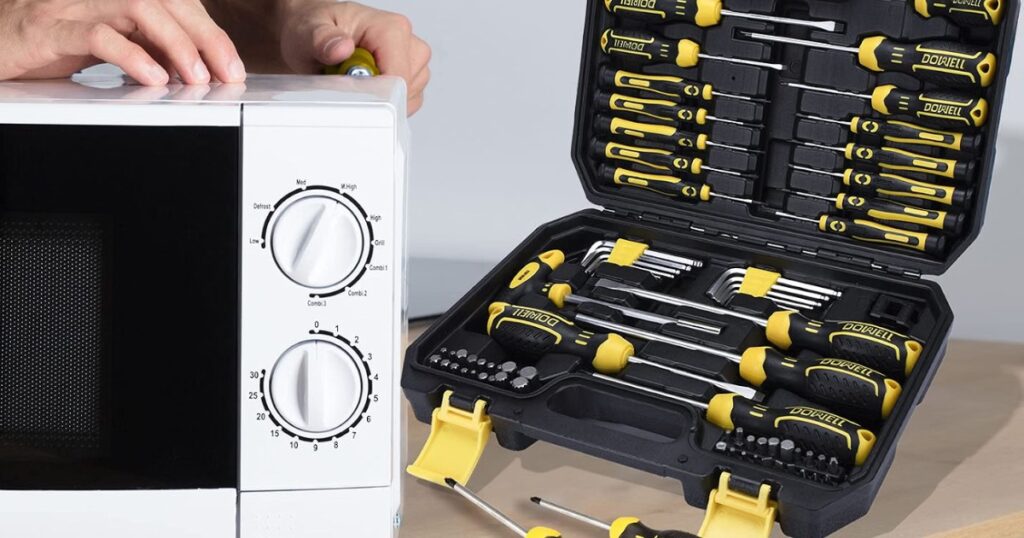
| 2 | Multi-bit screwdriver | #1 and #2 Phillips plus two slotted sizes | Klein Tools 32476 |
| 3 | Tape measure | 25 ft, with long standout for measuring alone | Stanley FATMAX 33-725 |
| 4 | Pliers | Tongue-and-groove, lineman’s, locking, needle-nose with cutter | Channellock, Klein, IRWIN |
| 5 | Utility knife | Retractable blade, blade storage, positive lock | Stanley Classic 99 |
| 6 | Adjustable wrenches | One small, one large; jaw capacity, not length | WORKPRO 6 in and 10 in |
| 7 | Hex keys | Metric and SAE, long arm, ball end | Amazon Basics 26-piece |
| 8 | Staple gun | Takes a common staple size you can buy anywhere | Arrow T50 |
| 9 | Handsaw | 15 in general-purpose, hardened teeth | IRWIN 2011201 |
| 10 | Level | 24 in box beam with a stated accuracy | DeWalt DWHT43224 |
| 11 | Stud finder | Shows the full stud width, warns of live wires | Franklin Sensors ProSensor M210 |
| 12 | Cordless drill and bits | Two batteries, a clutch, two speeds, a mixed bit set | DeWalt DCD771C2 with 100-piece bits |
| 13 | Eye protection and gloves | ANSI Z87.1 marked glasses; coated grip gloves | NoCry, MaxiFlex |
| 14 | Electrical tester | Non-contact voltage pen plus a plug-in outlet tester | Klein Tools 80025 kit |
| 15 | Ladder | Fiberglass, duty rated for your weight plus load | Louisville Ladder FS1506 |
| 16 | Caulking gun | Drip-free, thrust ratio matched to the product | Newborn 930-GTD |
| 17 | Drywall and putty knives | A wide taping knife and a narrow stiff blade | Goldblatt set, Hyde 5-in-1 |
| 18 | Roller frame and covers | 9 in frame that takes a pole; nap matched to the wall | Wooster Sherlock, Purdy White Dove |
| 19 | Paint brushes | 2½ in angled sash inside; 3 in flat outside | Purdy |
| 20 | Paint tray and liners | 9 in tray to match the roller, disposable liners | Mister Rui 9 in tray set |
Hand tools: the drawer you open every week
1. Hammer
The case for a 16-ounce steel hammer is balance. Lighter heads bounce off anything bigger than a picture hook; heavier framing hammers tire a wrist that only swings one twice a month. Sixteen ounces drives a nail into a stud without drama and still lets you tap a stuck drawer runner back into line.
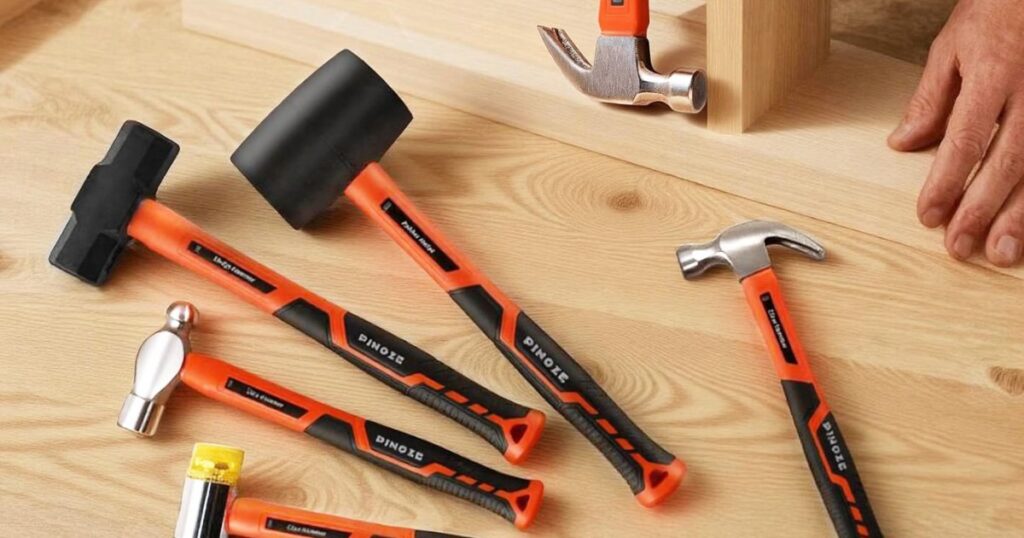
Worth correcting one piece of common advice, though. A straight rip claw is the better tool for prying boards apart, splitting old trim and demolition, because the flat claw wedges into a seam. For pulling nails, a curved claw gives more leverage, since the curve rolls against the surface as you pull. Estwing’s own listings describe them exactly that way. If most of your hammer work is hanging, assembling and removing the odd bent nail, the curved claw is the one you want. If you expect to open up walls or strip out old skirting, buy the rip claw.
The detail that separates a good hammer from a cheap one is construction. A head welded or glued onto a separate handle is a joint that can loosen. Estwing forges the E3-16S from one piece of steel, so there is no joint to fail, and wraps the handle in a shock-reduction grip that takes the sting out of a missed strike.
- Estwing E3-16S — 16 oz smooth face, rip claw, forged in one piece of steel, shock-reduction grip.
- Estwing E3-16C — the same hammer with a curved claw, for people who mostly pull nails.
2. Multi-bit screwdriver
Four screwdrivers in one handle is the right idea, provided the four are the four you actually meet. In a house that means #1 and #2 Phillips, which cover almost every cross-head screw in furniture, switch plates and appliances, and two slotted widths for older hardware and the screws on electrical fittings.
Be careful with search results here. Several of the best-selling “4-in-1” drivers are precision electronics screwdrivers with tiny tips made for terminal blocks, and they will cam out of a cabinet hinge screw on the first turn. Read the tip sizes, not the headline.
Klein’s 32476 carries exactly the household set — #1 and #2 Phillips, 1/4 in and 3/16 in slotted — and the shaft doubles as a 5/16 in nut driver, which is the size on a lot of appliance panels and hose clamps. That fifth function is why it is a 5-in-1 rather than a 4-in-1, and it earns its place.
3. Tape measure
Twenty-five feet is the length that covers a room corner to corner without the bulk of a 35-footer. The length on the label matters less than two figures most people never look at.
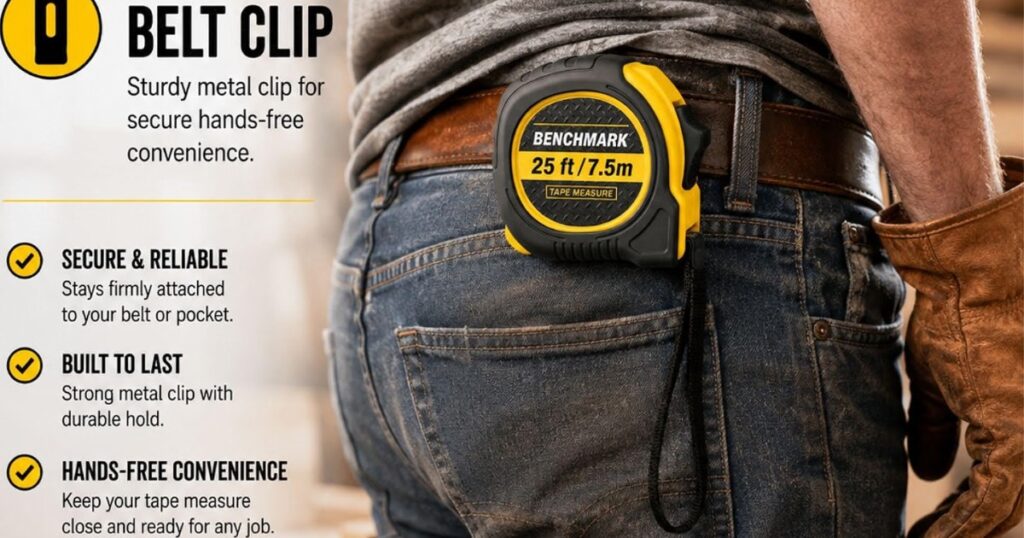
The first is standout: how far the blade extends horizontally before it buckles. That is what decides whether you can measure a wall alone or need someone holding the end. The second is blade width. A wider blade stands out further and survives being dropped on its edge. Look also for a true-zero hook that slides by its own thickness, so inside and outside measurements both read correctly.
Stanley’s FATMAX 33-725 is the long-standing benchmark in this size. Stanley quotes 14 feet of reach for it, marked with an asterisk, so treat that as a best-case figure measured under their conditions. It has a coated blade for abrasion resistance and a rubber-armoured case for the drops.
4. Pliers: the four that do different jobs
Pliers are the category where buying a big mixed set usually goes wrong, because the set pads its count with sizes you never use and skimps on the four patterns you do. Each of these four does something the others cannot.
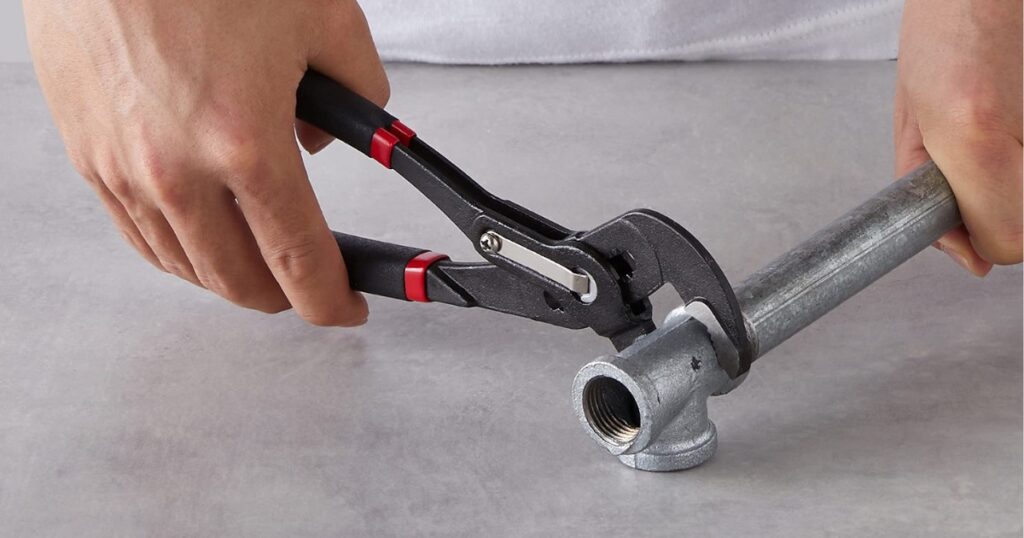
Tongue-and-groove pliers. Often called channel-locks, after Channellock, the company that popularised them. The jaws adjust across a series of grooves, so one tool grips a small nut or a large plumbing fitting. This is the plier for the sink trap, the shower head and the garden hose connector. Channellock’s TG-1 set gives you a 9½ in and a 12 in pair in high-carbon C1080 steel with laser heat-treated teeth. Two sizes is genuinely useful, because the long pair reaches behind a basin and the short one fits where the long one will not.
Lineman’s pliers. Flat, square jaws for gripping and twisting, with a hardened cutter behind them for wire. If you ever join two lengths of wire, straighten a bent bracket or cut a zip tie flush, this is the tool. Klein’s D213-9NE is the 9-inch standard: the rivet sits closer to the cutting edge for leverage, which Klein says gives 46 percent more cutting and gripping power than other plier designs — their comparison, not an independent measurement — and the cutting knives are induction hardened.
Locking pliers. Often called Vise-Grips, which is IRWIN’s trademark. A screw in the handle sets the jaw gap, and squeezing locks the jaws shut so the plier grips on its own. That makes them a third hand for holding two pieces together while glue sets, or for getting purchase on a bolt head that has already rounded off.
They are also the plier most likely to cause the problem they are meant to solve. Locking pliers clamp hard, and on a soft brass or aluminium nut in good condition they chew the flats. Use a wrench first. Reach for locking pliers when the wrench no longer grips. IRWIN’s 10-inch curved-jaw model (4935576) is the classic all-rounder, since the curved jaw holds round stock as well as flats.
Needle-nose pliers. Long, slim jaws for reaching into the back of a light fitting, retrieving a screw that dropped behind an appliance or bending a loop in wire. Buy a pair with a side cutter at the hinge and you remove the need for a separate pair of snips for light wire. Klein’s D203-8 has the cutter, induction-hardened cutting knives and extended 8-inch handles for reach.
5. Utility knife
Opening boxes is the least of it. A utility knife scores plasterboard so it snaps clean, trims carpet, cuts roofing felt, strips old caulk and sharpens a pencil. Three things matter: a blade that retracts fully into the handle, somewhere to store spare blades, and a nose that holds the blade without wobble, because a blade that shifts mid-cut is how people cut themselves.
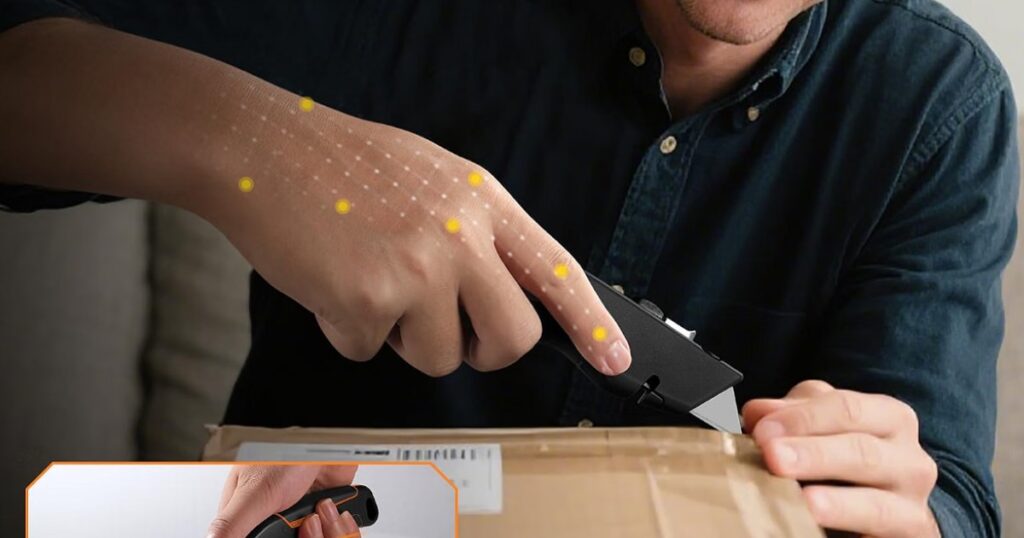
Stanley’s Classic 99 has done all three for decades. The blade has three locking positions, spares live in the handle and the patented interlocking nose clamps the blade from both sides. The two-pack is worth it; keep one in the kitchen drawer and one with the tools. Change the blade the moment it starts tearing rather than cutting. A dull blade needs more force, and force is what makes a knife slip.
6. Adjustable wrenches
Two adjustable wrenches cover most household nuts, one small for tight spaces and one large for plumbing. The usual advice is a 6-inch and a 14-inch; a 10-inch is enough for most homes and a good deal easier to fit under a sink. Whatever you choose, the figure to check is jaw capacity, the widest the jaws open, not overall length. Two wrenches of the same length can open to noticeably different widths.
The technique matters as much as the tool. Set the jaws snug on the nut, turn so the force goes toward the fixed jaw rather than the adjustable one, and re-tighten the worm screw between turns. A loose adjustable wrench is how round nuts are made.
WORKPRO’s two-piece set is a 6-inch and a 10-inch in drop-forged chrome vanadium steel, with SAE and metric scales etched on both sides of each jaw. Credit to the listing for its honesty: it describes the set as built for household and workshop jobs and explicitly not for industrial or high-stress mechanical work. That is the right expectation for a homeowner’s pair.
7. Hex keys
Flat-pack furniture ships with one hex key, usually made of soft metal, usually lost by the time the wardrobe needs tightening. A proper set replaces that key and every other one you will ever be given.
Buy a set with both metric and SAE sizes. Most flat-pack furniture uses metric, while a lot of North American fixtures, door handles and bikes use inch sizes, and the two are close enough that the wrong one fits loosely and strips the socket. Look for long arms for leverage and ball ends, which let you turn a bolt from an angle when the head is behind a panel. Use the square end for the final tightening, since a ball end carries less torque.
Amazon Basics’ 26-piece set covers both systems in long-arm, ball-end, chrome vanadium keys with a case that keeps them in size order. Bondhus is the step up if you use hex keys professionally; for a household drawer, this set is the sensible spend.
8. Staple gun
A staple gun re-covers a dining chair in an evening, fixes insulation and sheeting in a loft, holds landscape fabric down and tacks a cable run neatly along a skirting board. The one thing that matters more than the gun itself is the staple it takes. Buy a gun that uses a common size you can find in any hardware shop, or you will own a tool with no ammunition.
The Arrow T50 is the reason the T50 staple is a common size. It is a manual gun with a high-leverage handle, a rear-loading magazine with a jam-resistant mechanism and a window that shows when you are running low. For upholstery, use a shorter staple so it does not punch through a thin frame; for timber and insulation, go longer.
9. Handsaw
Even a house with a circular saw needs a handsaw. It cuts where a power saw cannot reach, trims a shelf without dragging out an extension lead, finishes a cut a power saw stopped short of, and prunes a branch without anyone needing safety glasses and ear defenders.
A 15-inch saw is long enough for a decent stroke and short enough for a toolbox. The trade-off to understand is tooth coarseness. Coarse teeth cut fast and leave a rough edge, which is right for timber, garden work and anything that will be hidden. Fine teeth cut slowly and cleanly, which is right for trim and shelving. IRWIN’s 2011201 is the coarse-cut version, with Tri-Ground teeth, deep gullets to clear sawdust and a tapered nose for starting cuts. If most of your cutting is visible trim, buy the fine-cut version or a Japanese pull saw instead.
Measuring and finding: getting it right the first time
10. Level
Eyeballing works for a single picture and fails for a row of three, a shelf, or a curtain rail that runs the width of a window. A 24-inch level is the household length: long enough to bridge a shelf bracket pair, short enough to use in an alcove.
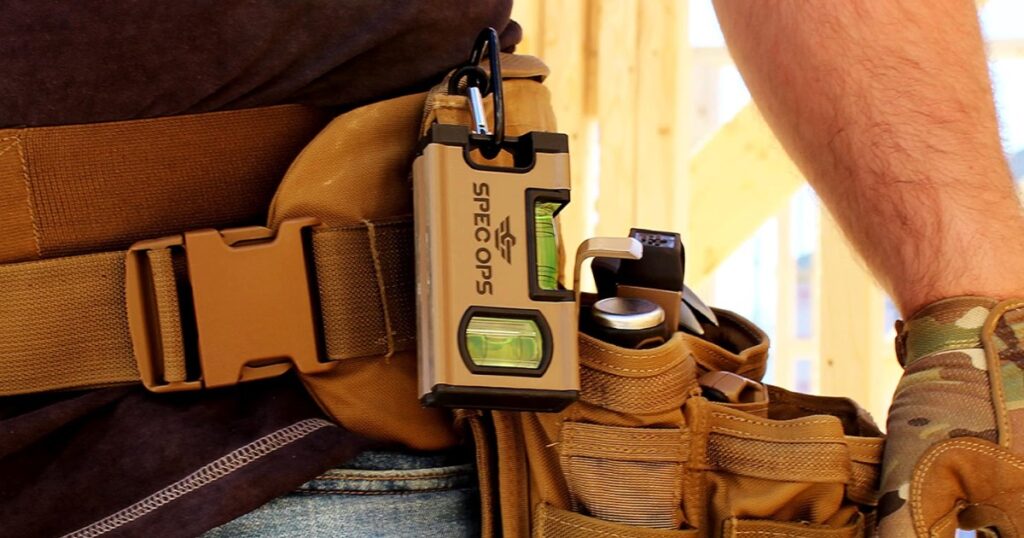
Two features separate a good level from a decorative one. A box beam, a rectangular hollow section, resists flexing and sits flat against a wall. And a stated accuracy, printed or listed, tells you the maker is confident in the vials. DeWalt’s DWHT43224 quotes block vials accurate to 0.0005 in per inch and a magnified centre vial that is easier to read from an awkward angle. Check any level by reading it, flipping it end for end on the same surface and reading again; the bubble should sit in the same place both ways.
11. Stud finder
A television bracket, a heavy mirror or a wall cabinet needs a stud behind it, not a plasterboard anchor and hope. A stud finder removes the knocking-and-guessing stage, and the better ones also warn you before you drill into a live cable.
Conventional electronic finders use one or two sensors and report an edge, which you then mark and re-scan from the other side. Multi-sensor finders show the whole width of the stud at once. Franklin Sensors’ ProSensor M210 uses 13 sensors, needs no calibration, lights up the full width of the stud and double studs, and includes live-wire detection. Its cheaper sibling, the M150, uses nine sensors and gives an AC wire warning.
Two limitations apply to every electronic finder. Old lath-and-plaster walls, dense tile backers and foil-backed insulation all confuse them. In those walls, a cheap magnetic finder that locates the nails and screws holding the wall to the studs is often more reliable. And no live-wire warning is a guarantee, so treat it as a prompt to check, not permission to drill.
The power tool: one drill, done properly
12. Cordless drill with bits
If you buy one power tool, this is it. A cordless drill driver hangs curtain rails, assembles furniture, drills pilot holes, drives decking screws and, with a hole saw, fits a door handle. The spec to look for is a clutch, the numbered collar behind the chuck that stops the drill when a screw reaches the set tightness, so you do not strip the head or sink the screw through the board. Two speed ranges matter too: low for driving screws, high for drilling.
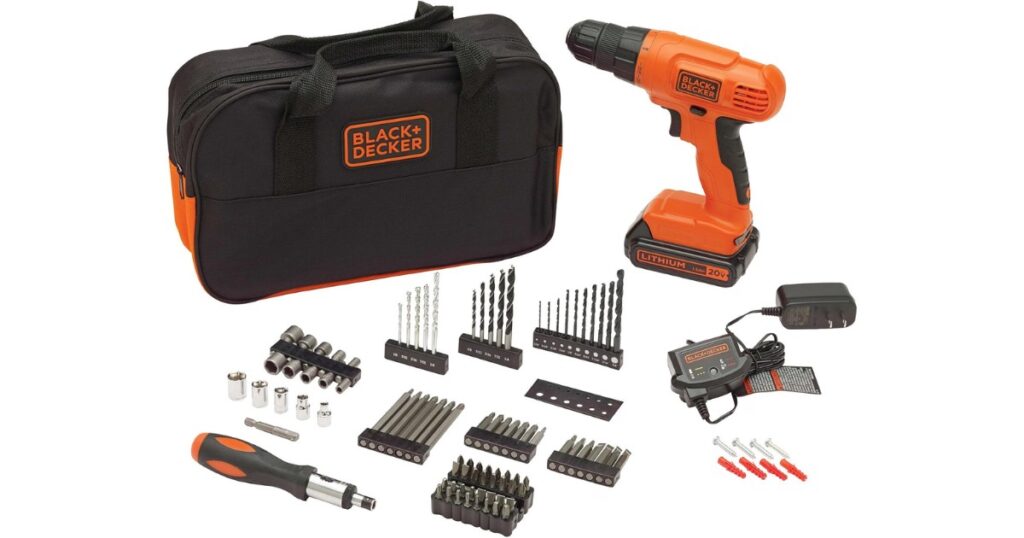
The spare battery point in the original list is the best advice in it. A drill that dies halfway up a ladder is worse than no drill. Buy a kit with two batteries and keep one on charge.
DeWalt’s DCD771C2 is the homeowner standard: a compact drill driver with a 1/2 in ratcheting chuck, two speeds (0–450 and 0–1,500 rpm) and 300 unit watts out, supplied with two 1.3Ah batteries, a charger and a bag. The listing linked here bundles it with DeWalt’s 100-piece bit set, which covers drill bits for wood, metal and masonry plus driver bits. Two honest caveats. The 1.3Ah packs are small, so on a long job the second battery is not a luxury. And DeWalt’s “20V MAX” describes the pack’s maximum voltage with no load; the nominal voltage is 18 volts, the same class as every other brand’s 18-volt tools.
Outside North America: the charger in a US kit is built for a 120-volt supply. Check its rating before buying from Amazon US if your mains is 220–240 volts.
Some experienced DIYers prefer a corded drill because it never runs out of charge and delivers constant power for long masonry jobs. That is a fair trade, and we have set out both sides in corded versus cordless. If you are unsure whether you need a drill driver, an impact driver or a hammer drill, start with which one does every job, and to get the most from those batteries, see battery care that actually doubles pack life.
Safety: the three tools that stop the other seventeen hurting you
13. Protective eyewear and gloves
Safety glasses are the cheapest item on this list and prevent the most expensive injury. Drilling overhead, chipping out old grout, cutting tile and hammering all send fragments toward your face.
Buy glasses marked to ANSI Z87.1, the US safety eyewear standard; high-impact rated frames carry a Z87+ mark. Readers in Europe will see EN 166 instead. Wraparound lenses matter because debris does not always arrive head on. NoCry’s clear glasses are Z87.1 certified with polycarbonate wraparound lenses, adjustable arms and nose pads, and an anti-fog coating, which is the feature that decides whether you actually keep them on.
For gloves, match the glove to the job. A nitrile-coated knit glove keeps enough feel to handle screws while protecting against scrapes and giving grip on smooth materials, which suits most household work. MaxiFlex’s knitted nylon glove, made without seams, with a micro-foam nitrile palm is the popular choice in that style. It is a grip glove, not a cut-resistant one. If you are handling sheet metal, glass or broken tile, buy a glove carrying an ANSI/ISEA 105 cut level (A1 to A9) instead. We cover the detail in PPE people actually wear and impact-rated work gloves.
14. Electrical tester
Before you touch a light fitting, a socket or a switch, you need to know the circuit is dead, and the breaker label is not proof. Breakers get mislabelled; circuits get extended. A tester is the only way to know.
Two testers cover a homeowner’s needs. A non-contact voltage tester is a pen that beeps and flashes near a live AC conductor, so you can check a wire or a socket without touching metal. A plug-in outlet tester reads a socket’s wiring and shows common faults, such as reversed polarity or a missing earth, and tests whether a GFCI socket trips.
Klein’s 80025 kit contains both: the RT210 GFCI outlet tester and the NCVT1P non-contact voltage pen, which Klein rates for 50 to 1,000 volts AC. Use the pen with the live-dead-live habit: test it on a socket you know is live, test the circuit you have switched off, then test the known-live socket again. That last step confirms the pen did not fail in between. A non-contact tester can miss voltage in shielded cable or when its battery is low, so the habit is not optional.
Outside North America: the RT210 is made for standard North American 120-volt three-prong sockets and will not plug into other socket types. Buy a local outlet tester for your socket standard; the non-contact pen works regardless. For meters, CAT safety ratings and the tools an electrician carries, see the seven most crucial tools for a pro electrician.
15. Ladder
Most household falls happen from a height a person thought was too low to worry about. The right ladder, and the right habits on it, matter more than any other safety item.
For indoor work, a 6-foot stepladder reaches a standard ceiling. As a rule of thumb, your safe working reach is roughly four feet more than the ladder’s height, because you stand below the top. Two specifications decide which one to buy:
| Duty rating (ANSI) | Capacity | Suits |
|---|---|---|
| Type IAA | 375 lb | Extra heavy professional use |
| Type IA | 300 lb | Heavy use; the sensible household choice |
| Type I | 250 lb | Industrial light-to-medium use |
| Type II | 225 lb | Medium duty |
| Type III | 200 lb | Light household use |
The capacity has to cover your body weight plus the tools and materials you carry up. The second decision is material. Fiberglass does not conduct electricity, which is why it is the right choice for anyone working near light fittings, service cables or outdoor wiring. Aluminium is lighter but conducts.
Louisville Ladder’s FS1506 is a 6-foot fiberglass stepladder rated Type IA, 300 lb, with slip-resistant feet. Never stand on the top cap or the step below it, and keep three points of contact when climbing.
One point the original list skips: a 6-foot stepladder will not reach the gutters on most houses. That job needs an extension ladder, set at a 4-to-1 angle (one foot out from the wall for every four feet of height) and extending three feet above the edge you are stepping onto or working at. If gutter cleaning is the reason you are buying a ladder, buy the extension ladder, not the stepladder.
If the listing shows no buy button, it is usually a delivery-location restriction on large items rather than a discontinued product.
Sealing, patching and painting
16. Caulking gun
Resealing the gaps around windows, doors, baths and kitchen worktops is one of the cheapest improvements a homeowner can make. It stops draughts, keeps water out of the places it rots, and makes a bathroom look new. A caulking gun is what makes that a neat job rather than a smeared one.
Two specifications matter. Drip-free guns release pressure when you let go of the trigger, so the tube stops flowing instead of oozing onto the floor. Thrust ratio is how much force the trigger multiplies. About 10:1 is right for ordinary caulk and silicone; thick construction adhesive and cold sealant need 18:1 or more, or you will be squeezing with both hands.
Newborn’s 930-GTD is drip-free with a smooth hex rod, a 10:1 ratio and built-in extras including a scraper for removing old material and a tube cutter. If you expect to glue as much as you seal, the Newborn 250, with an 18:1 ratio and a revolving frame, handles both. Match the caulk to the job too: silicone for baths and showers, paintable acrylic for interior trim, and an exterior-grade sealant outside.
17. Drywall knife and putty knife
Every repaint starts with patching: nail holes, dents from furniture, cracks at the corners. Two blades do almost all of it. A narrow, stiff blade presses filler into small holes and scrapes off flaking paint. A wide, flexible taping knife feathers filler over a larger area so the patch disappears under paint instead of standing proud of the wall.
For the narrow blade, a painter’s 5-in-1 tool is worth more than a plain putty knife. Hyde’s 02970 is a 2½ in stiff blade that also scrapes, spreads filler, opens paint tins and squeezes paint back out of a roller. For wide work, Goldblatt’s five-piece stainless set runs from 6 in to 14 in with aluminium-backed blades. Most homeowners will live on the 6 in knife; the wider ones earn their place when a whole wall needs skimming.
Use lightweight spackle for nail holes, since it barely shrinks and can be painted quickly, and joint compound for larger repairs and anything needing tape. Two thin coats beat one thick one every time.
18. Roller frame and roller covers
A 9-inch roller is the standard wall and ceiling size. The frame matters more than people expect: a flimsy cage lets the cover wobble and leaves tramlines, and a frame that cannot take an extension pole means a ladder for every ceiling. That is the point behind choosing a handle a pole can attach to — you paint the ceiling standing on the floor, then take the pole off for work within reach.
Wooster’s R017-9 Sherlock frame takes 9-inch covers and has a quick-release retaining spring, so the cover stays put while painting and comes off with one rap. It is designed to lock onto Wooster’s Sherlock extension poles; if you already own a pole, check which fitting it uses before buying a frame.
The covers are where the finish is decided. Choose the nap by the surface: 3/8 in for smooth plasterboard and plaster, 1/2 in for light texture, 3/4 in and up for rough surfaces such as brick and render. Purdy’s White Dove covers are woven for a lint-free finish and suit latex and oil-based paints on semi-smooth to semi-rough surfaces; the 3/8 in six-pack covers a whole house of interior walls.
For textured and decorative finishes, see faux finishing tools. For a whole-house exterior repaint, a sprayer may earn its cost, which we weigh up in the VEVOR 900W airless sprayer review.
19. Assorted paint brushes
Rollers do walls; brushes do everything a roller cannot reach. Two brushes cover most homes, and the reasoning for each is specific.
A 2½ inch angled sash brush is for interior cutting-in — painting the line where wall meets ceiling or trim. The angle puts a fine point on the bristles so you can draw a straight line freehand. Purdy’s 2½ in angle sash brush uses a firm nylon and polyester blend on a hardwood handle.
A 3 inch flat brush is for exterior trim, fascia boards and wider surfaces, where it carries more paint per dip. Purdy’s XL Sprig 3 in is a medium-stiff Tynex nylon and Orel polyester brush that Purdy rates for latex and oil-based paint, inside and out.
Bristle type follows the paint. Synthetic nylon and polyester blends suit water-based paint because they do not absorb water and go limp; natural bristle is traditionally used with oil-based paint. A good brush, washed properly straight after use and hung to dry, lasts for years — which is why buying one good brush beats buying a pack of cheap ones that shed into your wet paint.
20. Paint tray with liners
A tray sized to your roller is the difference between loading the cover evenly and dunking half of it. Match a 9-inch tray to a 9-inch roller. Liners are the part people skip and regret: you pour paint into the liner, roll from it, and at the end either pour the leftover back into the tin or throw the liner away, leaving a clean tray for the next colour.
Mister Rui’s set is one 9-inch tray and ten liners, with a pour spout in the corner for returning excess paint to the tin and a magnetic holder that grips the metal ferrule of a brush so it does not slide into the paint. The listing states it is made from polypropylene; the liners make the tray the rarely washed item it should be.
What to buy first
Twenty tools is a sensible destination, not a shopping list for one weekend. Buy in the order problems arrive.
| When | Tools | Why then |
|---|---|---|
| Moving-in week | Hammer, multi-bit screwdriver, tape measure, utility knife, hex keys, cordless drill and bits, safety glasses | Every flat-pack wardrobe, curtain rail and picture hook of the first month |
| First repair | Pliers, adjustable wrenches, electrical tester, stepladder, gloves | The dripping tap, the dead light fitting and the smoke alarm on the ceiling |
| First project | Level, stud finder, handsaw, staple gun, caulking gun | Shelves, a mounted TV, resealing a bath, re-covering a chair |
| First repaint | Putty and taping knives, roller and covers, brushes, tray and liners | Buy these together, the week you choose the colour |
An electrical tester sits in the second row, not the first, only because you should not be doing electrical work in your first week. Buy it before you touch any wiring at all.
A kit, or tools bought one by one?
A pre-assembled home tool kit is tempting and cheaper per piece. The problem is the piece count. Kits reach a big number with dozens of sockets and bits that look useful in the box, while the tools you use most — the hammer, the tape, the pliers — are often the lowest-grade items in the set. Buying the core tools individually at a proper specification and adding a kit later for the odd sizes is usually the better use of money. We looked at what a starter set should actually contain in our 45-piece hand tool kit review.
Frequently asked questions
What is the single most useful tool for a homeowner?
A cordless drill driver with a set of bits. It hangs, assembles, drills and drives, and it replaces a drawer of manual screwdrivers for anything bigger than a switch plate. Buy a kit with two batteries so it is never flat when you need it.
Should a homeowner buy a rip claw or a curved claw hammer?
A curved claw if most of your hammering is hanging pictures, assembling furniture and pulling out bent nails, because the curve gives more leverage for pulling. A rip claw if you expect to do demolition or pry boards and trim apart, because the straighter claw wedges into seams. Both come in 16 oz, which is the right weight for household use.
Are metric or SAE hex keys better?
Neither is better; you need both. Most flat-pack furniture uses metric sizes, while many North American fixtures, bikes and door handles use inch sizes. The two are close enough that the wrong key fits loosely and strips the fastener, so buy a set that includes both systems.
Is a non-contact voltage tester enough before working on a light fitting?
It is the minimum, and only when used live-dead-live: confirm the pen on a known live source, test the switched-off circuit, then confirm the pen again on the live source. Non-contact testers can miss voltage in shielded cable or with a weak battery. If you are not confident isolating a circuit, hire an electrician; a tester reduces risk but does not replace competence.
What size ladder does a homeowner need?
A 6-foot fiberglass stepladder for indoor ceilings, rated Type IA (300 lb) so the capacity covers your weight plus what you carry. For gutters and upper-storey exterior work you need an extension ladder, set at a 4-to-1 angle and extending three feet above the edge you are working at. A stepladder is the wrong tool for gutters.
Which paint roller nap should I buy?
Match the nap to the surface. 3/8 inch for smooth plasterboard and plaster, which covers most interior walls; 1/2 inch for lightly textured walls; 3/4 inch or longer for rough surfaces such as brick, block and render. A longer nap holds more paint but leaves more texture on a smooth wall.